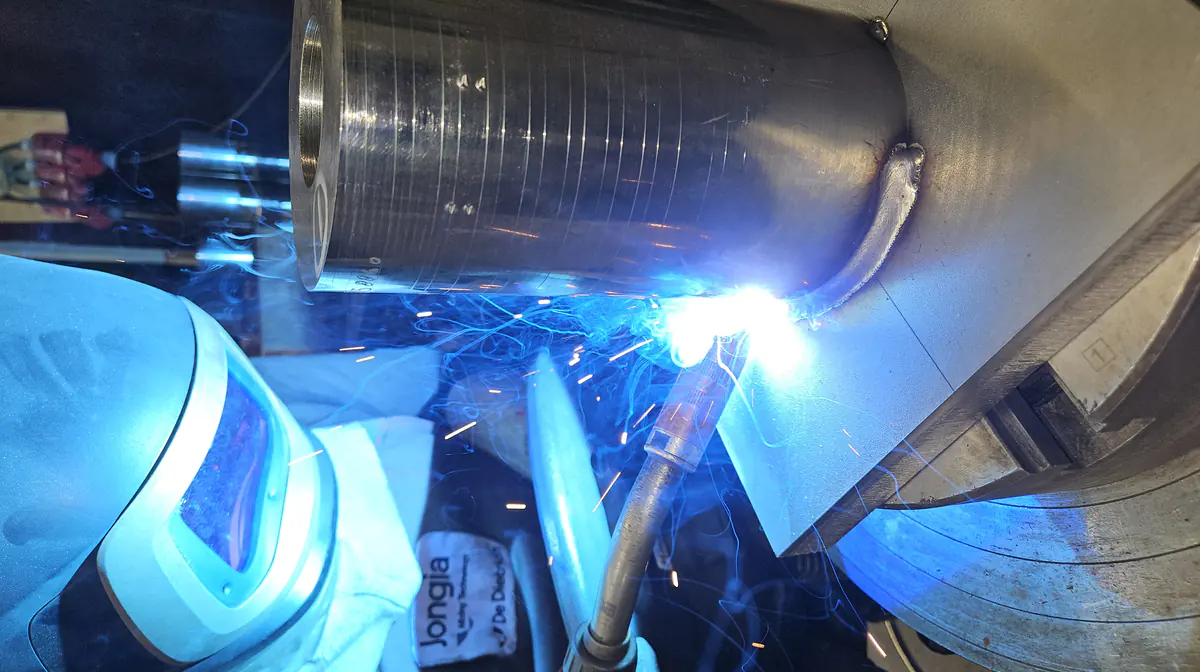
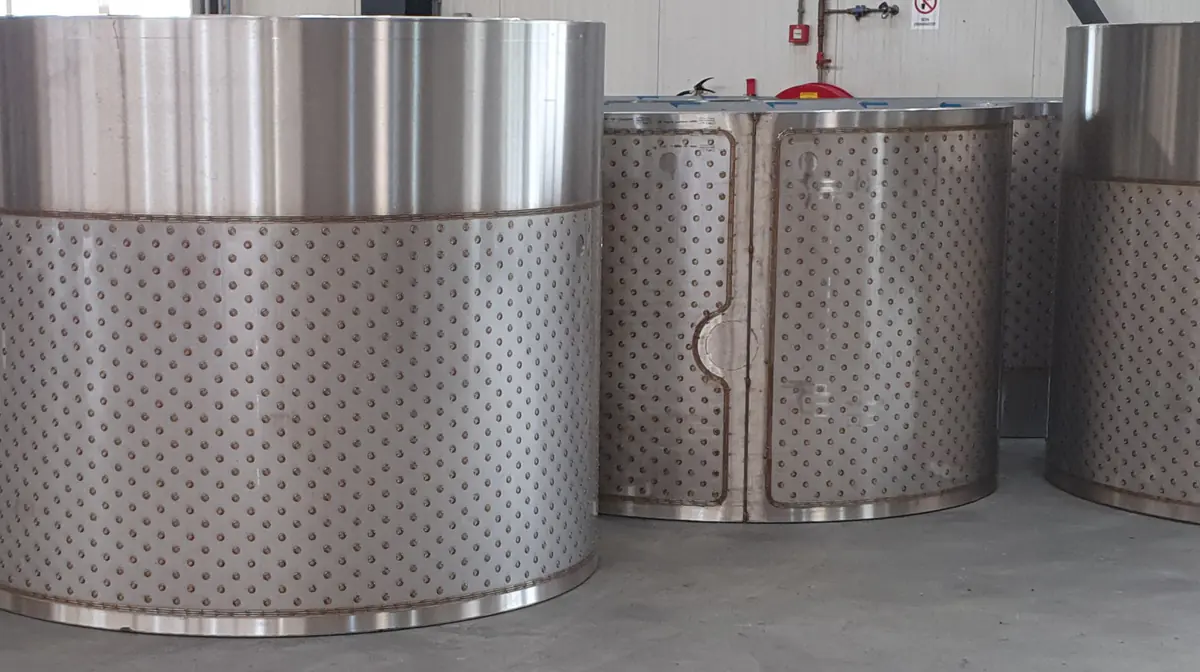
WPQR qualification to EN ISO 15614-1 and ASME IX
A welding procedure qualification record, or WPQR, demonstrates that your welding procedure produces sound welds under production conditions. For work governed by EN 1090-2, ISO 3834 or the Pressure Equipment Directive 2014/68/EU, a valid WPQR is often a firm contractual requirement. DEHAAS manages the complete qualification process to EN ISO 15614-1 or ASME IX, from initial scoping through to the approved record.
- Smart scoping, wide range of approval
- EN ISO 15614-1 and ASME IX
- One contact for lab and examiner
- Independent, nationwide coverage
We are an independent consultancy based in Menaam, Friesland, working hands-on for clients across Europe and North America. We have no interest in extra test pieces or repeat trials, only in a qualification that passes first time and covers as much of your production as possible.
When do you need a WPQR
A WPQR is required whenever a standard, a client or a legal framework calls for qualified welding procedures. Under EN 1090-2 that applies from execution class EXC2 upwards, under ISO 3834-2 and ISO 3834-3 certification, and for pressure equipment covered by PED 2014/68/EU. Many clients also demand qualification where no formal obligation exists, simply because it proves the process is under control.
If you are unsure whether your situation requires one, our knowledge centre article on when a WPQR is needed is a good starting point. We can also review your contract and standards and tell you exactly what does and does not need qualifying.
Defining the scope intelligently
The biggest savings in a qualification project are made before any welding starts. Every WPQR carries a range of approval: a span of material thicknesses, material groups, welding processes and joint types. Fabricators who weld test pieces without a plan end up qualifying again for every project.
DEHAAS first maps your current and expected production. We then define the smallest number of test pieces that covers the largest share of that work, for instance by selecting a test piece thickness that yields a broad thickness range, or a material that covers several material groups. The result is a qualification package that lasts for years.
Test piece and welding trial
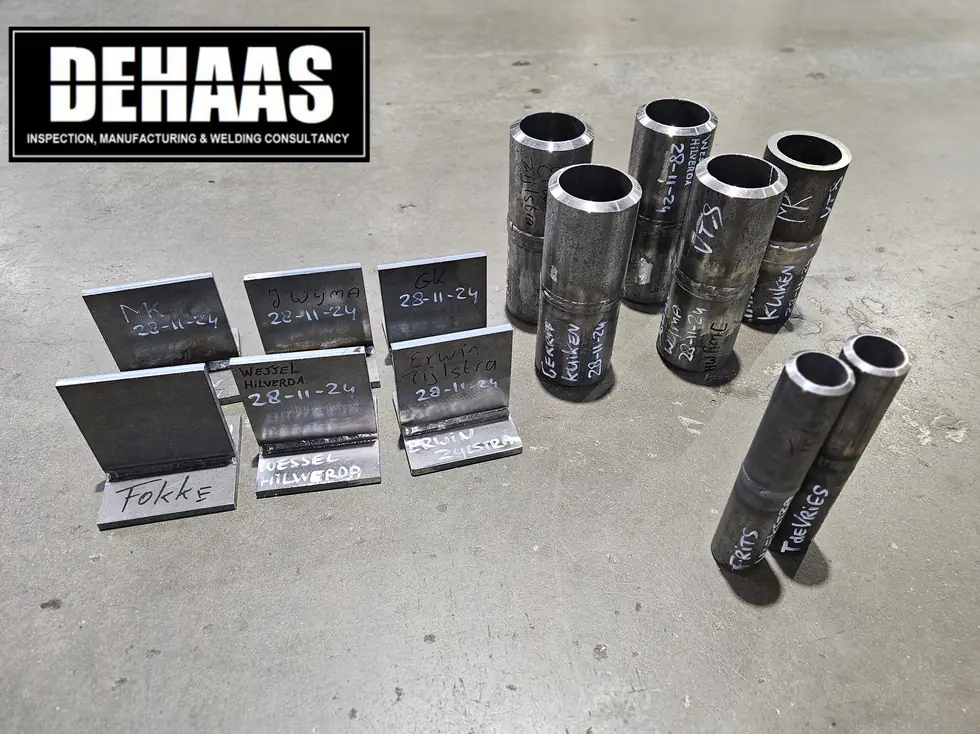
We prepare a preliminary welding procedure specification, the pWPS, covering the process, filler material, preheat, interpass temperature and target parameters. The test piece is welded to that pWPS by one of your own welders, witnessed by the examining body.
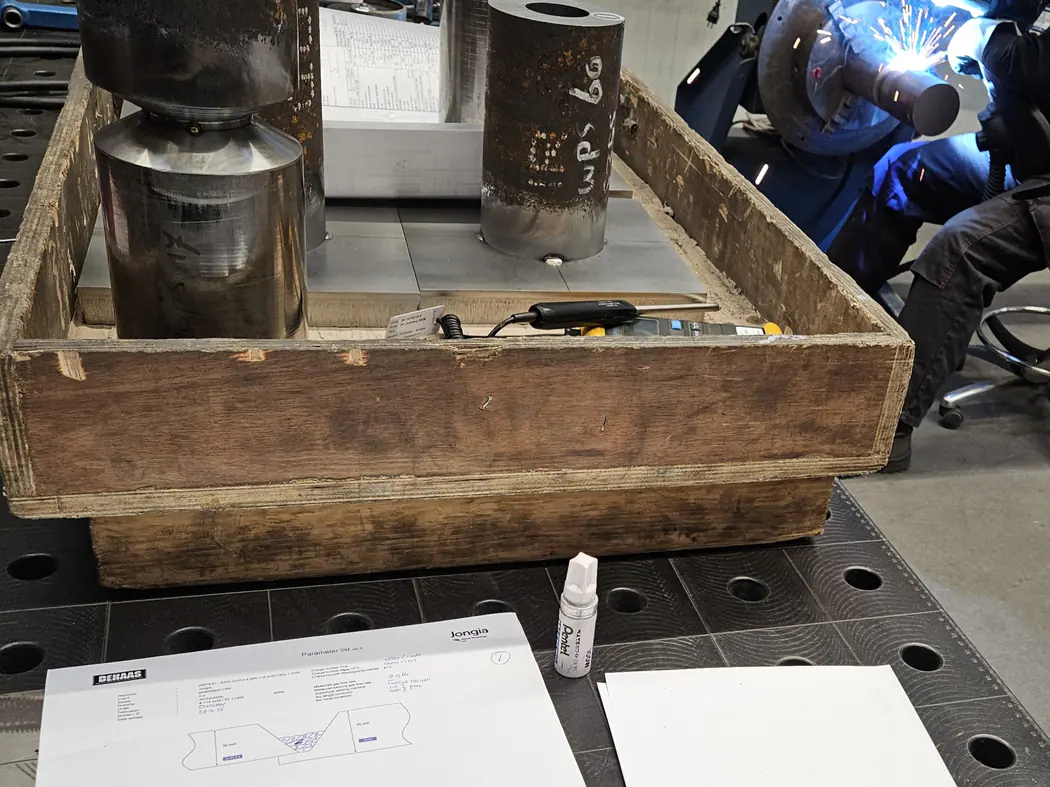
We prepare the trial properly: material with the correct certificates, a welder who is comfortable with the job, calibrated equipment for current, voltage and temperature, and a realistic set-up. All actual parameters are recorded during welding, because they help define the range of approval. A well prepared trial avoids repeats and discussion afterwards.
Test programme: NDT and mechanical testing
After welding, the test piece goes through a fixed test programme. EN ISO 15614-1 requires non-destructive testing, including 100 percent visual examination and, depending on material and joint type, radiographic or ultrasonic testing plus surface inspection by penetrant or magnetic particle methods.
The destructive part follows: tensile tests, bend tests, impact tests at the specified temperature, hardness surveys and macro examination. The exact programme depends on material, thickness and application. Qualification to ASME IX places the emphasis on tensile and bend testing, with its own rules for impact testing. We fix the programme in writing beforehand, so the laboratory and the examiner expect the same tests and nothing is missed or duplicated.
Laboratory and examining body
Several parties are involved in a qualification: a test laboratory, preferably accredited to ISO/IEC 17025, and an examiner or examining body that witnesses the trial and endorses the WPQR. For pressure equipment under the PED this is a notified body.
DEHAAS is independent and operates no laboratory of its own. We obtain quotations, compare lead times and rates, and coordinate the schedule between your workshop, the laboratory and the examining body. You keep a single point of contact who reviews every document before it becomes final.
Lead time and cost structure
The cost of a WPQR is built up from fixed elements: test piece and filler material, welding hours, non-destructive testing, mechanical testing, the examining body and the reporting. Testing and witnessing are usually the largest items, which is why smart scoping lowers the cost per production weld so effectively.
Allow several weeks for a standard EN ISO 15614-1 qualification, driven mainly by laboratory and examiner scheduling. Where possible we run activities in parallel, preparing the working documentation while the laboratory is still testing, so production can start as soon as the record is approved.
Range of approval and next steps
A WPQR to EN ISO 15614-1 has, in principle, no expiry date. Its range of approval is defined for thickness, diameter, material group, welding process and position, among other variables. Within that range you draw up welding procedure specifications, the WPSs your welders use in production.
DEHAAS converts the approved record into practical WPS documentation and keeps it aligned with your welder qualifications to ISO 9606-1, so the paperwork matches the shop floor and stands up to audits and client reviews.
Frequently asked questions
A WPQR to EN ISO 15614-1 remains valid indefinitely in principle. No periodic requalification is required unless a contract, product standard or client specification says otherwise. Production must, of course, stay within the range of approval.
That depends on material, thickness, welding process and the required test programme. Mechanical testing and the examining body are usually the largest items. We provide a cost breakdown per test piece up front, so there are no surprises.
The WPQR is the qualification record, containing the test results and the range of approval. The WPS is the working instruction for the welder, written within that range. Without a valid WPQR, a WPS has no demonstrable basis.
Yes. By choosing test piece thickness, material group and process carefully, one qualification can cover a wide span of production work. That is exactly what we aim for during scoping.
More from the knowledge centre
Have a welding or QA/QC question?
Ask the DEHAAS Welding & Quality Assistant, have your case reviewed by a specialist, or call us directly.