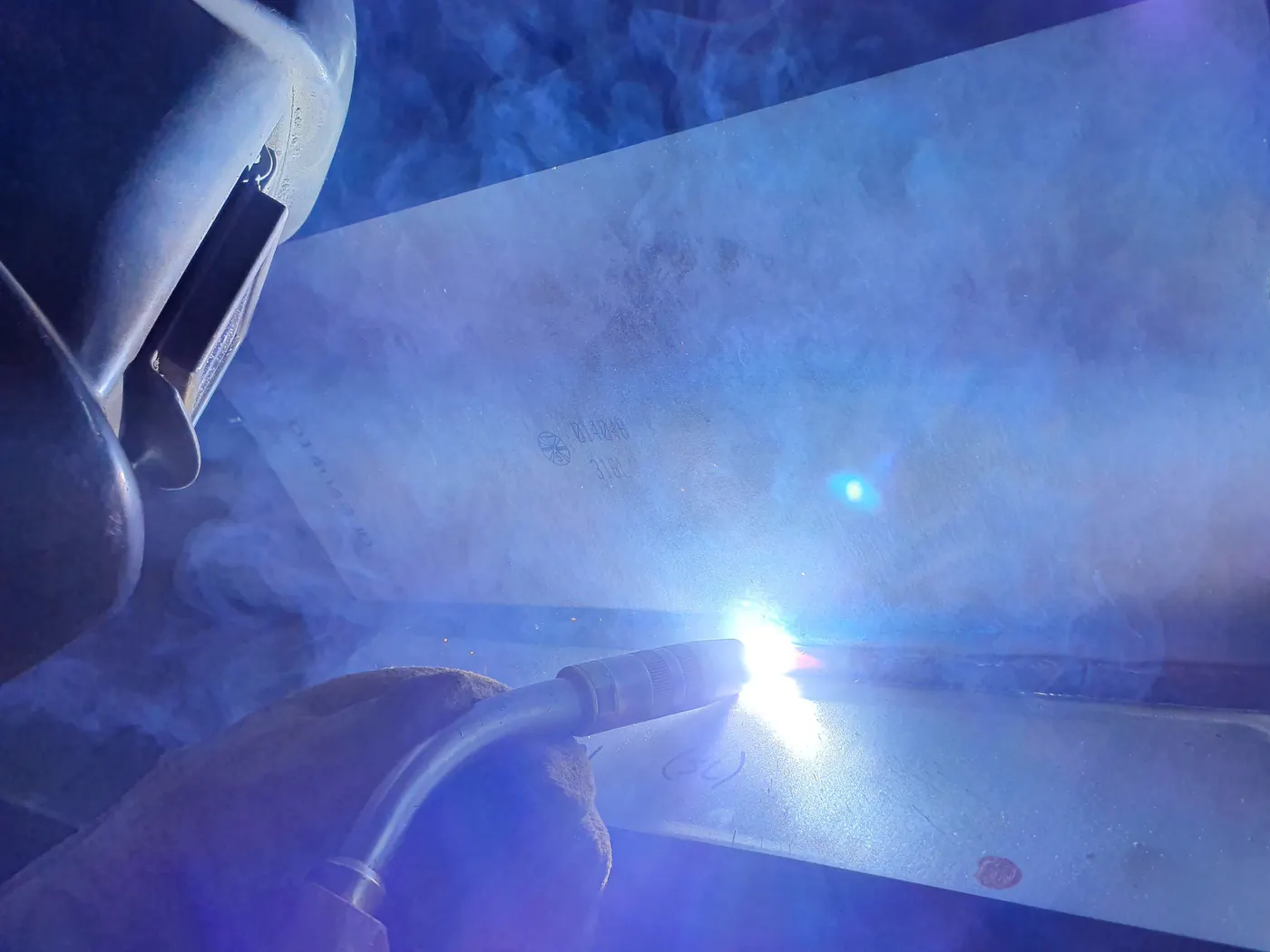
Welding galvanised steel
Welding galvanised steel happens daily and commonly goes wrong on three fronts at once: the welder's health, the quality of the weld and the corrosion protection destroyed by welding. All three are manageable, but not without measures.
This article covers what zinc does in the arc, how to avoid porous welds and how to restore the coating.
Zinc fume and health
Zinc vaporises at around 907 degrees, well below the melting point of steel. Zinc fume is therefore always released in the arc and inhaled as fine zinc oxide particles. That causes metal fume fever: flu-like symptoms a few hours after welding that pass within a day but are not harmless when repeated.
Local exhaust ventilation is a necessity here, not a recommendation, supplemented by respiratory protection where extraction is ineffective. The exposure limit for zinc oxide is quickly exceeded when welding galvanised material without extraction. See welding fume and occupational health.
Porosity and spatter
Zinc vapour forms before the steel melts and is absorbed into the pool. On solidification it escapes, causing porosity, spatter and an unstable arc. The result is a weld that looks poor and is often rejected on examination.
The best remedy is removing the coating locally, roughly 20 to 50 mm either side of the joint, by grinding or blasting. Where that is impossible, work at lower travel speed with a slightly dragging torch angle so the vapour has time to escape before the pool solidifies.
Liquid metal embrittlement
On high strength steel and on stainless steel, molten zinc can penetrate along grain boundaries and locally embrittle the material. That phenomenon, liquid metal embrittlement, causes cracks that sometimes only appear later.
On austenitic stainless the risk is real: a drop of molten zinc on a hot stainless surface is enough. Keep galvanised material separate from stainless work and never use galvanised fixtures or clamps on stainless welding.
Restoring the coating
After welding the zinc coating around the joint is gone or burnt. That zone corrodes first. Restoration is done with zinc rich paint, thermal spraying or zinc solder sticks, depending on the requirement.
ISO 1461 sets the requirements for repairing hot dip galvanised surfaces, including minimum coating thickness, which generally must equal or slightly exceed the original. Include that step in the inspection plan, because it is frequently forgotten on the floor.
Frequently asked questions
For a sound weld, preferably yes. On non-critical joints welding straight through is common, at the cost of spatter and porosity. For structural welds and where a quality level applies, removal is the only reliable route.
Yes, and that is often the better sequence. Do allow for venting and drainage holes in closed sections, for distortion in the zinc bath and for the risk of zinc embrittlement on heavy welds with high residual stress.
Local exhaust as close to the arc as possible, supplemented by general ventilation. In confined spaces or where extraction cannot reach, independent respiratory protection is required. This is one of the situations where a dust mask is not enough.
Procedure qualification is performed on bare material. Welding through the coating in production is a departure from the conditions qualified, and that must be described in the WPS and the procedure.
More from the knowledge centre
Have a welding or QA/QC question?
Ask the DEHAAS Welding & Quality Assistant, have your case reviewed by a specialist, or call us directly.