Offshore and marine
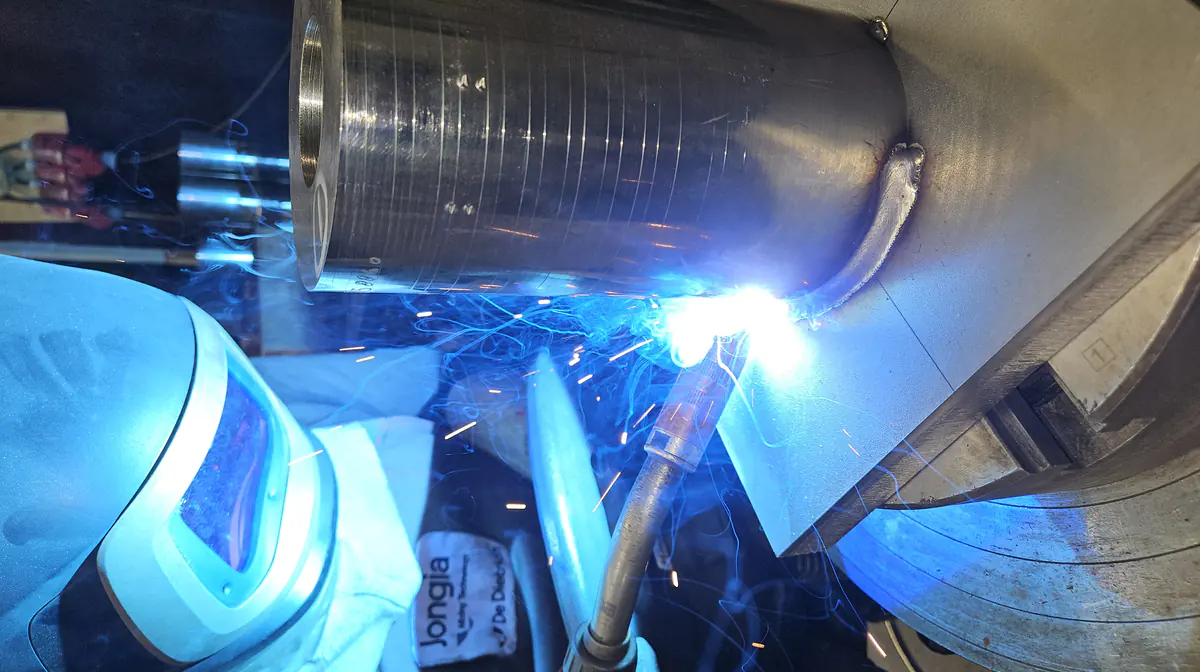
Offshore and marine welding differs from ordinary steel construction in two ways. First, the classification society or the operator is directly involved in approving procedures and welders, with their own rules on top of the ISO standards. Second, testing covers properties rarely seen elsewhere: low temperature notch toughness, CTOD for fracture mechanics and resistance to hydrogen sulphide.
- Qualification under DNV, Lloyd's Register and Bureau Veritas
- CTOD and HIC testing on critical joints
- NORSOK M-101 and sour service to ISO 15156
- Third party inspection at the yard and at suppliers
DEHAAS supports yards, fabricators and suppliers within that framework: qualification programmes, welding plans, NDT coordination and inspection on behalf of the client.
Classification society and operator specification
DNV, Lloyd's Register, Bureau Veritas and ABS each have their own rules for welding procedures, welder qualification and consumables. A WPQR to EN ISO 15614-1 is often accepted, but usually with additional requirements and always subject to surveyor approval.
On top of that the operator imposes a project specification, for example based on NORSOK M-101 or a company standard. That specification overrides the general standard. The first task in any project is therefore to establish that document hierarchy, so it does not emerge halfway that a procedure was built on the wrong standard.
CTOD and notch toughness
For structures loaded at low temperature, and for joints underpinning a fracture mechanics assessment, CTOD testing to BS 7448 or ISO 15653 is required. That test measures the critical crack tip opening displacement and is far more demanding than a Charpy test.
Crucially, CTOD coupons must come from a joint representative of production, with the same heat input and the same coarse grained zone. A coupon welded with more favourable parameters gives a result production cannot repeat. That is one of the most common points of discussion during approval.
Sour service and corrosion
Where hydrogen sulphide is present, ISO 15156 applies, better known in practice as NACE MR0175. It limits the hardness of weld and heat affected zone, usually to 250 HV10, and sets requirements for material and heat treatment.
That limit drives the whole procedure: higher preheat, controlled heat input and sometimes mandatory stress relief. See hardness testing. In seawater, corrosion requirements add duplex and superduplex as common materials; see welding duplex.
Inspection at the yard and at suppliers
Offshore projects are rarely built at one location. Sections come from subcontractors, sometimes abroad, and are joined elsewhere. Quality therefore stands or falls with inspection at source.
DEHAAS performs vendor inspection and third party inspection: review of procedures and certificates beforehand, attendance at hold points, verification of NDT and assessment of the dossier. See vendor inspection and third party inspection.
Frequently asked questions
Usually as a basis, but almost always with additional requirements and always subject to surveyor review. Some societies require the coupon to be welded in their presence. Confirm that before welding, not after.
When the project specification requires it, which is common for heavy sections, low design temperatures and wherever an engineering critical assessment is made. A Charpy test does not replace CTOD: they measure different things.
NORSOK M-101 is a Norwegian industry standard for structural steel offshore, with stricter requirements for qualification, NDT extent and documentation than EN 1090-2. Working for a Norwegian operator, NORSOK usually governs and EN 1090 alone is not sufficient.
Yes. We carry out vendor inspection in Europe and beyond, reporting in English and working to the client's inspection and test plan. See vendor inspection abroad.
More from the knowledge centre
Have a welding or QA/QC question?
Ask the DEHAAS Welding & Quality Assistant, have your case reviewed by a specialist, or call us directly.