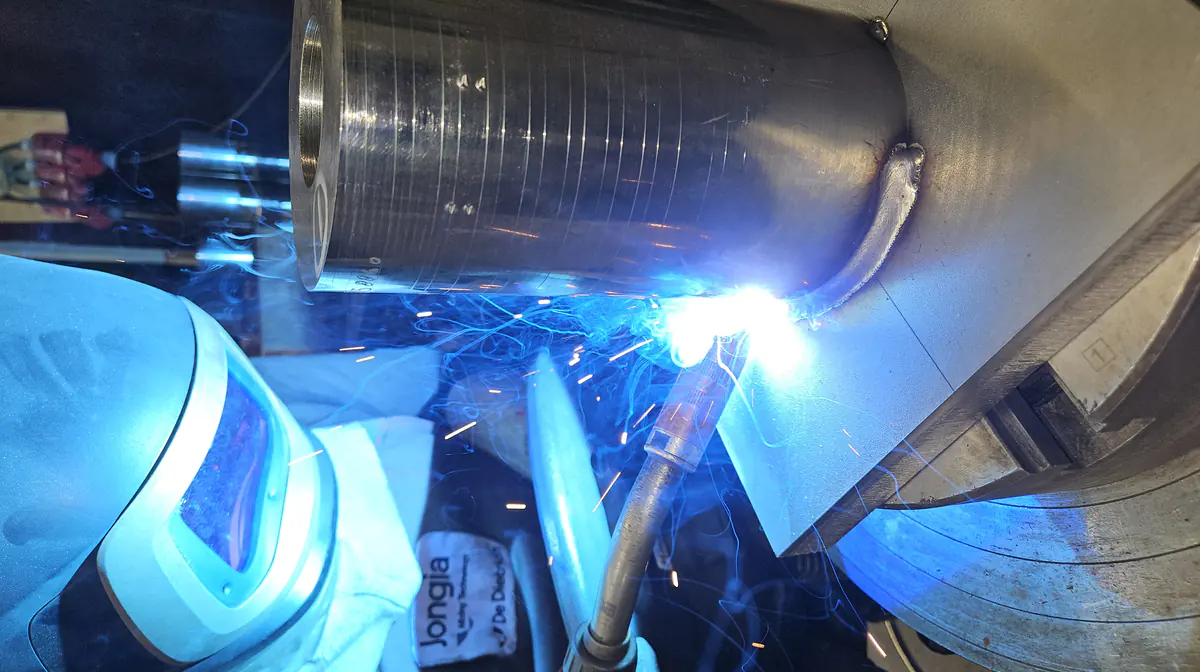
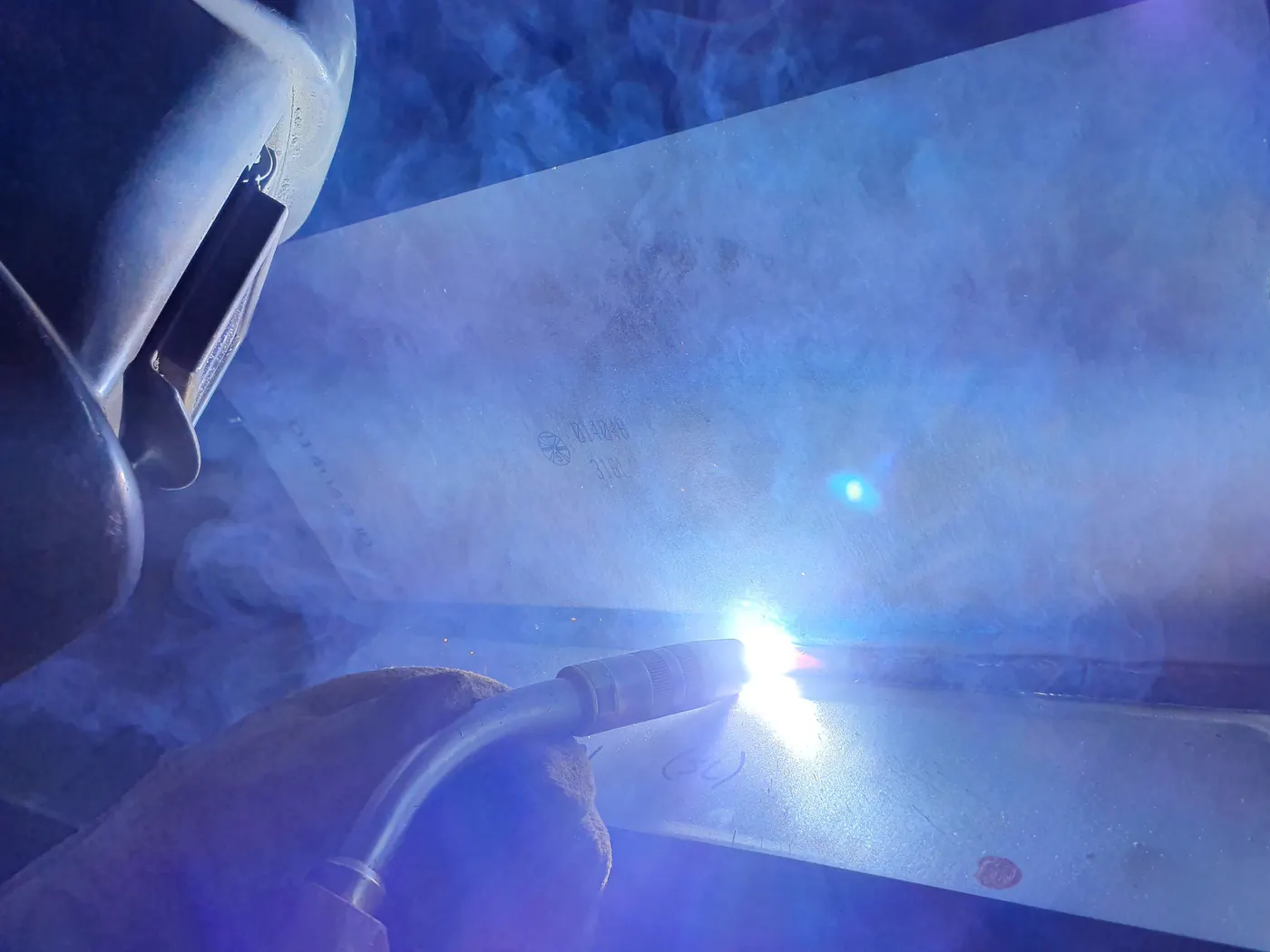
Food and pharmaceutical
In the food and pharmaceutical industry a weld is judged not mainly on strength but on cleanability. Every crevice, every undercut and every rough patch is a place where product remains and bacteria grow. The structural requirement is subordinate to the hygienic one.
- Hygienic design to EHEDG and 3-A
- Orbital welding with full data recording
- Root protection and heat tint within limits
- Weld by weld documentation and traceability
DEHAAS supports installers and equipment manufacturers in this segment: welding procedures for orbital welding, root protection, acceptance criteria for heat tint and the documentation that survives a validation.
Hygienic design
EHEDG guidelines and the 3-A standards describe how piping and equipment must be built to be cleanable: no dead legs longer than a few diameters, fully penetrated joints, no overlaps and no crevices, and a surface roughness usually at Ra 0.8 micrometres or below.
For the welding that means butt welds only with full penetration, roots that lie flush without suck-back or excessive penetration, and no fillet welds in product contact. Any departure from that is not a cosmetic flaw but a contamination risk.
Orbital welding as the standard
Manual welding rarely achieves the required consistency in root geometry. Orbital GTAW with a closed weld head delivers a repeatable root and records current, voltage, speed and gas flow for every weld. That record is often part of the validation.
It requires accurate joint preparation: tube ends must be cut square and machined, with a minimal gap and matched wall thickness. Tolerances on tube and fittings are therefore kept tight. See TIG and orbital welding.
Root protection and heat tint
The root side must be purged with backing gas until residual oxygen is well below the limit, in this segment often 50 ppm or lower. A chromium depleted oxide on the root is unacceptable in product contact, because it both corrodes and is hard to clean.
Acceptance of heat tint is fixed with a colour chart, often based on AWS D18.2. Agree in advance which number is still acceptable and document it, otherwise handover brings a dispute about welds that are no longer accessible. See heat tint, pickling and passivation.
Documentation per weld
In pharmaceutical installations every weld is recorded individually: number, welder, machine, procedure, gas batch, date and the outcome of visual and endoscopic examination. A proportion of welds is inspected internally with a borescope, or a simultaneously welded coupon is retained as evidence.
That weld log is the heart of the handover dossier and is examined during installation qualification. See weld map and weld log.
Frequently asked questions
Usually Ra 0.8 micrometres or below for food, and in pharmaceutical applications often Ra 0.5 or 0.4, sometimes electropolished. The requirement is in the user requirement specification; check it before tube and fittings are ordered.
Only on the outside and only if the surface then still meets the roughness requirement. On the root side, dressing inside piping is practically impossible, which makes a rejected root a replacement of the pipe section.
Because cleaning fluid does not pass it at sufficient velocity. Product remains, spoils and contaminates the installation. The guideline is that a branch length must not exceed a limited multiple of the diameter; EHEDG gives concrete ratios.
No. In mechanised welding the welder becomes an operator and ISO 14732 applies instead of ISO 9606. The operator is qualified on setting up and monitoring the machine. See operator qualification.
More from the knowledge centre
Have a welding or QA/QC question?
Ask the DEHAAS Welding & Quality Assistant, have your case reviewed by a specialist, or call us directly.