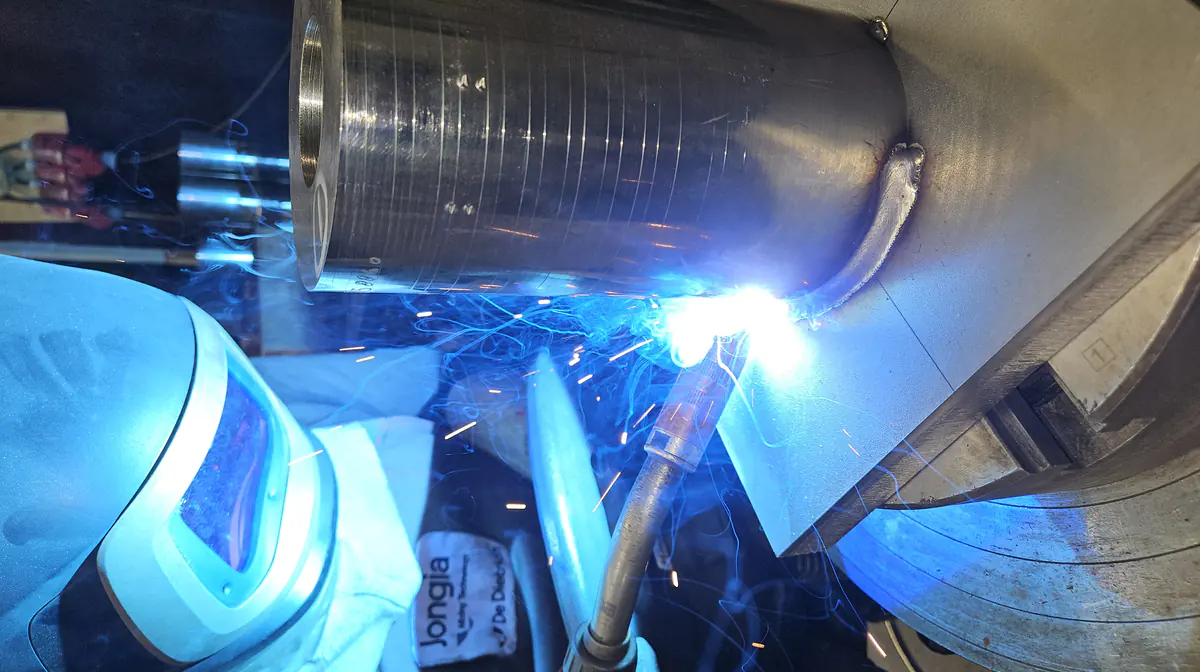
ISO 3834 support: from gap analysis to audit
ISO 3834 sets quality requirements for fusion welding and is the standard by which a fabricator demonstrates control of its welding operations. Weld quality can never be fully verified after the fact, so control has to sit in the process itself: in people, procedures, equipment and records. DEHAAS supports companies in structural steel, machine building, shipbuilding and the process industry across Europe and North America.
- Part 2, 3 or 4 chosen correctly
- Gap analysis with a concrete plan
- Welding coordination to ISO 14731
- Independent, nationwide coverage
We guide the whole journey: choosing the right part of the standard, running a gap analysis, filling the welding coordination role, getting procedures and qualifications in order and preparing your company for the certification audit. Independent, hands-on and without needless paperwork.
What ISO 3834 covers
ISO 3834 describes what a company must organise to weld in a controlled way: contract review, qualified personnel, suitable equipment, qualified welding procedures, material control, inspection and traceable records. The standard does not say what a weld should look like, but how you ensure that every weld complies.
That makes ISO 3834 the foundation under many other frameworks. EN 1090 refers to it directly for the welding part of factory production control, and it is widely required for pressure equipment under PED 2014/68/EU and in rail and shipbuilding. Certification is also a strong commercial argument towards clients who want weld quality demonstrated.
Part 2, 3 or 4: which level fits your work
The standard has three certifiable levels. ISO 3834-2 sets comprehensive quality requirements, ISO 3834-3 standard requirements and ISO 3834-4 elementary requirements. The right part depends on your products, the consequences of failure and what your clients or related standards demand. Fabricators working to EXC3 or EXC4 under EN 1090, for instance, end up at part 2.
Certifying too high means unnecessary cost and administration, too low means losing orders. We determine the level that genuinely fits. The differences are explained in our knowledge centre article on the parts of ISO 3834.
Gap analysis as the starting point
Every engagement starts with a gap analysis on your own shop floor. We work through all requirements of the chosen part and record, item by item, what you can already demonstrate and where the gaps are: from contract review and subcontracting to equipment calibration and consumable storage.
The result is not an abstract report but a concrete action list with priorities, owners and a realistic schedule towards the audit. Companies often do most things well already and mainly lack the evidence. In that case we focus on demonstrability rather than rebuilding everything from scratch.
Welding coordination to ISO 14731
ISO 3834-2 and 3834-3 require welding coordination with tasks and responsibilities as set out in ISO 14731. The coordinator reviews contracts for welding feasibility, assigns procedures and welders, monitors qualifications and decides on non-conformities. It is the pivot of the whole system.
DEHAAS fills this role as an external specialist or supports your own coordinator where knowledge or time is short. Read more on our welding engineering and coordination page. You comply with the standard and your shop floor gains a contact who understands welding.
Procedures and qualifications in order
Under ISO 3834-2 and 3834-3, welding procedures must be qualified, typically by WPQR to EN ISO 15614-1, and welders qualified to ISO 9606-1. Practical WPSs must be available at the workstation, and inspection and testing must match the acceptance criteria of ISO 5817.
We establish which qualifications your production actually needs, fill any gaps efficiently and turn everything into documentation your people genuinely use. We also set up inspection pragmatically, with clear agreements on who checks and records what, supported by our welding inspection and QA/QC services.
Going into the audit prepared
Once the system is in place, we prepare the certification audit with you. We run an internal trial audit under audit conditions: the same questions, the same burden of proof. Findings are resolved before the certification body arrives, and your people know what to expect.
We also remain available after certification. Surveillance audits, changed products, new welders or expiring qualifications: we keep the system correct, so the certificate is renewed each year without heroics and your welding operations remain demonstrably under control.
Frequently asked questions
No, the standard itself is not required by law. Certification is, however, frequently demanded by clients and is practically necessary through other frameworks, for example because EN 1090 refers to ISO 3834 for the welding part of production control.
That depends on your products, the consequences of failure and the demands of clients and related standards. Part 2 is comprehensive, part 3 standard and part 4 elementary. We advise the level that fits, not automatically the heaviest one.
From gap analysis to audit, allow a few months depending on your starting point. Lead time is driven mainly by any missing procedure qualifications and the certification body's schedule.
Yes. ISO 14731 allows the coordination role to be filled externally, provided tasks, authority and availability are properly defined. DEHAAS performs this role for companies across Europe and North America.
More from the knowledge centre
Have a welding or QA/QC question?
Ask the DEHAAS Welding & Quality Assistant, have your case reviewed by a specialist, or call us directly.