Preventing hydrogen cracking: mechanism and measures
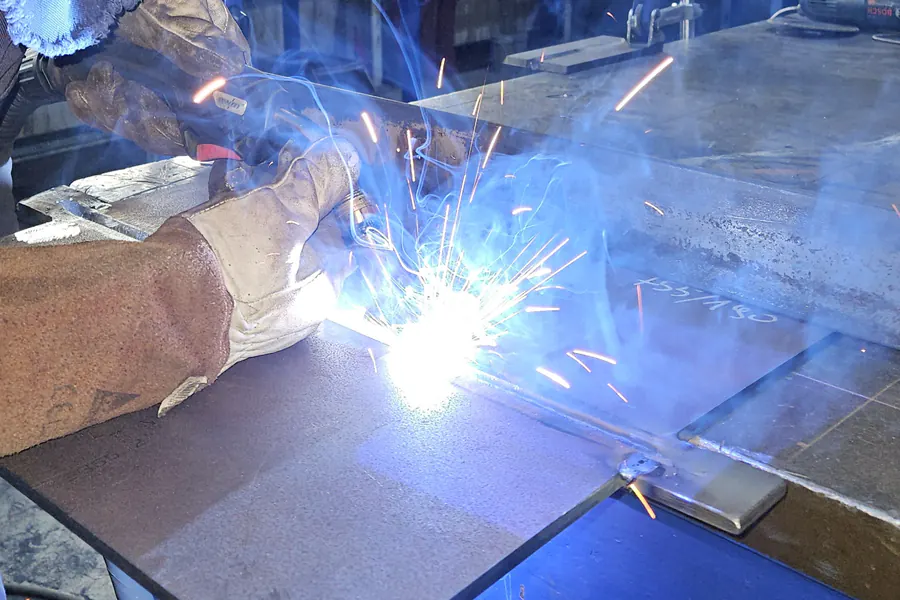
Hydrogen cracking, also known as cold cracking or delayed cracking, is among the most dangerous defects in carbon and low alloy steels. It does not form during welding but at low temperature, sometimes hours or even days later. Cracks are often small, frequently subsurface, and easily missed by inspection carried out too soon.
This article explains the mechanism, the risk factors and the measures that work: preheating, dry low hydrogen consumables, post heating and an appropriate hold time before non destructive testing, in line with EN 1011-2.
The mechanism: three factors at once
Hydrogen cracking only occurs when three factors coincide, at temperatures below roughly 150 to 200 degrees Celsius:
- Diffusible hydrogen in the weld metal and heat affected zone
- A susceptible hard microstructure, usually martensite or hard bainite
- Tensile stress from shrinkage, restraint or external loading
Hydrogen from the arc dissolves in the hot weld pool. On cooling, its solubility falls sharply and it diffuses towards regions of high stress and hard microstructure, where it locally embrittles the steel until a crack initiates and grows step by step. Because diffusion takes time, cracks can appear up to 48 hours after welding or later.
Remove any one of the three factors sufficiently and no crack forms. Every countermeasure is based on this.
Where hydrogen cracks occur
Most hydrogen cracks form in the heat affected zone: toe cracks, underbead cracks parallel to the fusion line and root cracks. In high strength steels and heavy multi pass welds, transverse cracks can also occur in the weld metal itself.
Because many of these cracks are subsurface or very fine, visual inspection alone is not enough. Ultrasonic and magnetic particle testing are the usual detection methods.
Recognising the risk factors
- A high carbon equivalent, meaning a readily hardenable steel
- High strength steels from about S460, particularly quenched and tempered grades
- Large combined thicknesses and therefore fast cooling
- Low heat input, for example small tack welds or thin root runs
- High restraint at nodes, repairs and stiff assemblies
- Moisture in electrodes or flux, and rust, grease, paint or condensation on the joint
- Low ambient temperatures and outdoor welding
HAZ hardness indicates susceptibility. EN ISO 15614-1 applies a maximum of 380 HV10 for most structural steels in procedure qualification, while sour service to ISO 15156 requires far lower limits, around 250 HV.
Preheat and interpass temperature
Preheating is the primary measure. It slows cooling so the HAZ is less hard, and gives hydrogen more time to escape at elevated temperature. EN 1011-2 offers two methods for the minimum preheat: method A based on carbon equivalent CE, and method B based on CET, intended mainly for modern fine grain and high strength steels.
Both take account of combined thickness, heat input and the hydrogen scale of the consumable. Maintain preheat during tack welding and between passes. See our article on preheating in welding for determining and verifying temperatures.
Dry, low hydrogen consumables
EN 1011-2 groups consumables into hydrogen scales, from A with more than 15 ml per 100 g of deposited weld metal to E with 3 ml or less. Consumables carry designations such as H5, H10 or H15, measured to ISO 3690.
- Specify H5 or lower for crack sensitive steels
- Bake basic electrodes as specified and hold them in a heated quiver or oven
- Use vacuum packed electrodes within the stated time after opening
- Keep flux and cored wire dry and prevent condensation
- Present joints dry, clean and free of rust, grease and paint
Never underestimate the shop floor: a box of electrodes left open overnight in a cold hall can undo every calculation.
Post heating and heat treatment
For heavy wall and highly crack sensitive work, the joint can be held at elevated temperature for several hours immediately after welding, without cooling in between. This hydrogen release treatment, typically around 200 to 300 degrees Celsius, lets hydrogen diffuse out before the critical temperature range is reached. Record duration and temperature in the WPS.
This differs from stress relieving. A full post weld heat treatment reduces residual stress and hardness, and with it the risk of hydrogen cracking.
NDT hold time and stress control
Because hydrogen cracks are delayed, inspection immediately after welding has limited value. EN 1090-2 specifies minimum hold times depending on steel grade, weld size and heat input, rising to 40 hours for high strength steels with large welds. In offshore and pressure vessel specifications, 48 hours is not unusual. Record the hold time in the inspection and test plan along with the times of welding and testing.
Also limit stress: ensure good fit up without large gaps, avoid unnecessary restraint, plan the welding sequence and prevent stray arc strikes, which create hard spots. Sound NDT coordination ensures that method, timing and acceptance criteria are right.
Frequently asked questions
Because it forms at low temperature after the weld has cooled, usually below about 150 degrees Celsius, unlike hot cracking or solidification cracking, which occurs as the weld metal solidifies.
Austenitic weld metal holds a lot of hydrogen and releases little into the HAZ, so it is sometimes used for repairs on difficult steels. It is not a general solution: strength, thermal behaviour and qualification must suit the application.
Yes. Tack welds are small and cool very quickly, which makes them particularly crack prone. The same preheat and consumable requirements apply as for the main weld.
Check the project specification and the applicable standard first, for steel structures EN 1090-2. If nothing is specified, set a hold time based on steel grade, weld size and hydrogen risk and record it in the inspection and test plan.
More from the knowledge centre
Have a welding or QA/QC question?
Ask the DEHAAS Welding & Quality Assistant, have your case reviewed by a specialist, or call us directly.