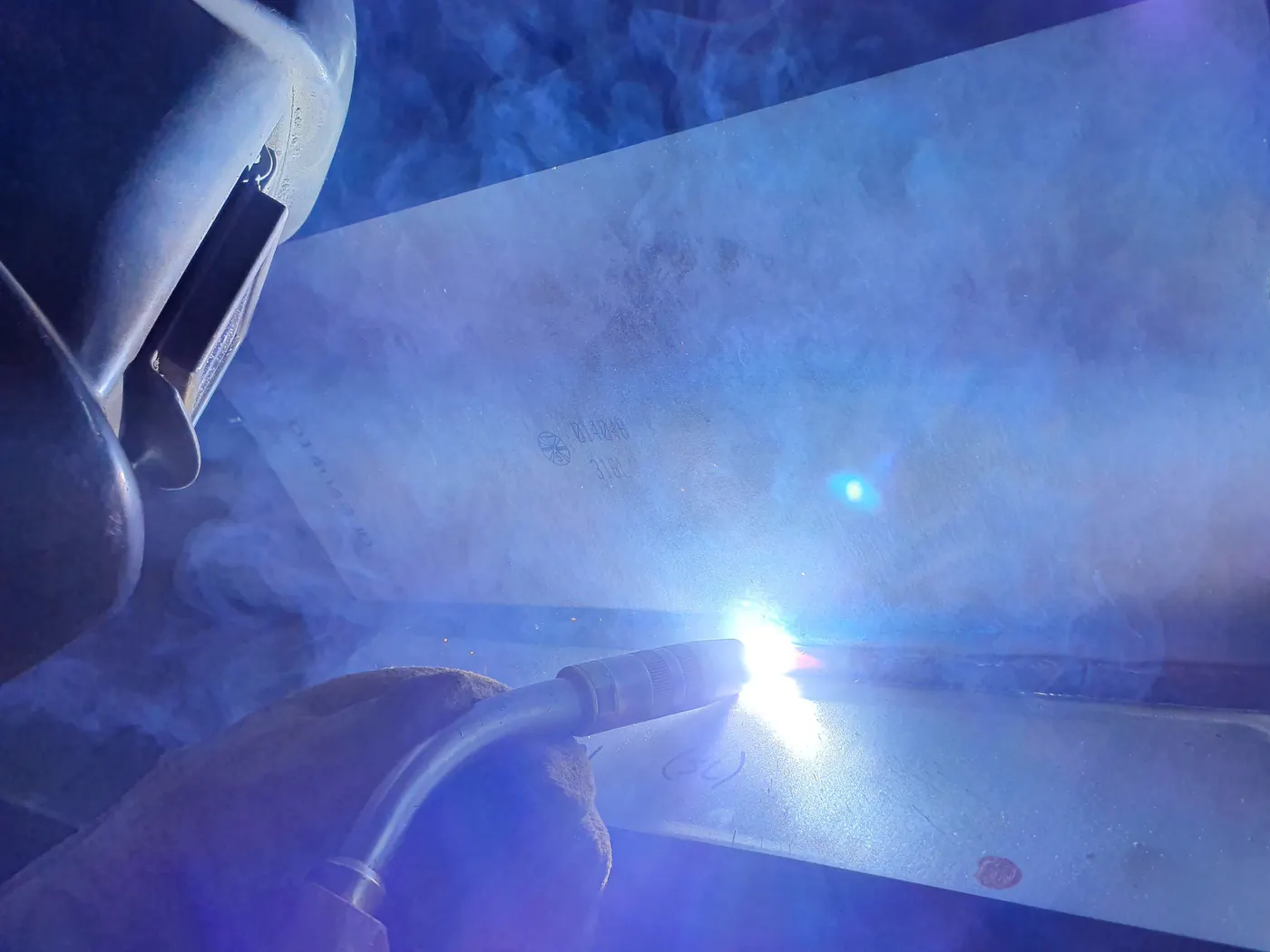
Preheating in welding: when is it required
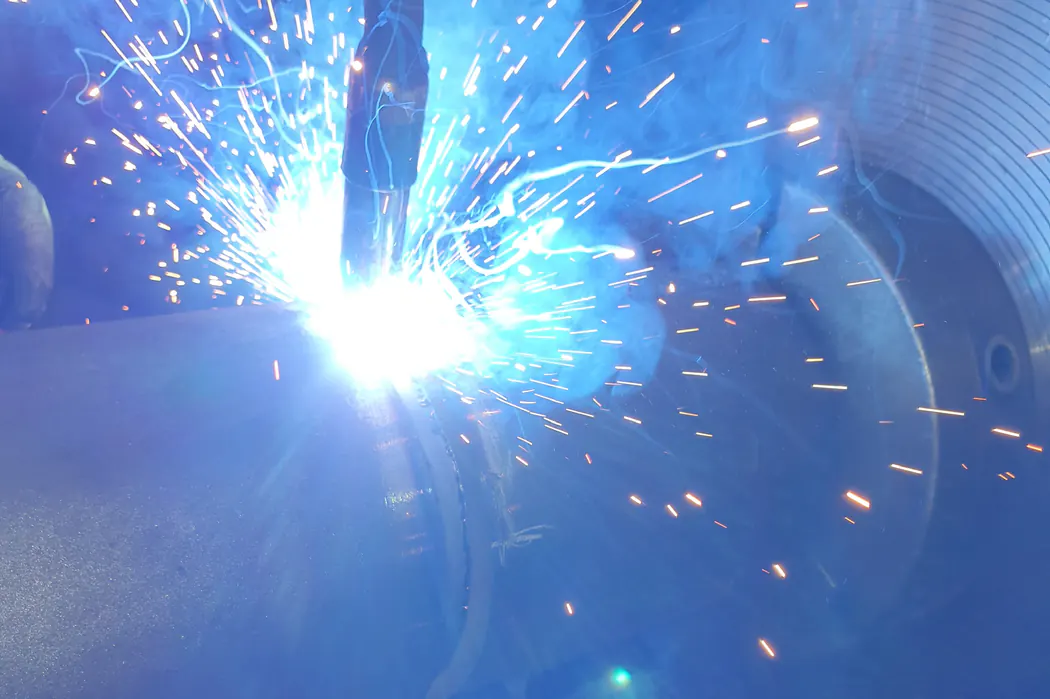
Preheating is one of the most underestimated welding parameters. It governs how quickly the weld and heat affected zone cool, and therefore which microstructure forms. Rapid cooling produces hard, brittle martensite that is prone to hydrogen assisted cold cracking. Preheating slows the cooling rate, gives hydrogen time to escape and reduces shrinkage stresses. The real question is not whether preheating helps, but when it is mandatory and how you control it.
This article explains how carbon equivalent, combined thickness and hydrogen control determine the required preheat temperature, and how to carry out and verify preheating in practice. The approach follows EN 1011-2 and the measurement method of ISO 13916.
Why preheat: cooling rate and microstructure
During welding, the surrounding cold material draws heat away from the joint very quickly. In carbon and low alloy steels with sufficient hardenability, this produces martensite in the heat affected zone. Combined with hydrogen and restraint stresses, that hard structure is the classic recipe for cold cracking, which often appears hours after welding.
Preheating reduces the temperature gradient. The cooling time between 800 and 500 degrees Celsius, the t8/5, increases, hardness in the heat affected zone stays lower and hydrogen has more time to diffuse out. Preheating also drives off condensation and improves fusion on heavy sections.
Carbon equivalent as the first indicator
A steel's sensitivity to hardening is expressed by its carbon equivalent. The most common formula is the IIW CEV: CEV = C + Mn/6 + (Cr + Mo + V)/5 + (Ni + Cu)/15, calculated from the cast analysis on the material certificate rather than from specified maximum values.
As a rule of thumb:
- CEV up to about 0.40: readily weldable, preheat usually only needed for heavy sections or low ambient temperatures
- CEV 0.40 to 0.45: consider preheating, particularly for thick, highly restrained joints
- CEV above 0.45: preheating is almost always required, with the temperature determined to EN 1011-2
EN 1011-2 provides calculation methods that combine carbon equivalent, combined thickness, heat input and hydrogen scale into a minimum preheat temperature. For modern fine grain steels the CET method in the same standard is often more appropriate.
Material thickness and heat sink
Thickness dictates how many paths the heat can take. A butt weld in thin plate loses heat in two directions, a fillet weld on heavy material in three. EN 1011-2 therefore works with the combined thickness: the sum of the average thicknesses of all members meeting at the joint. The greater that sum, the faster the cooling and the sooner preheat becomes necessary.
A common mistake is to consider only the thickness of one member. With fillet welds on heavy profiles, or thin stiffeners welded to thick material, the risk is then underestimated. Always state the combined thickness explicitly in the welding procedure specification.
Hydrogen control is part of the equation
Preheating and hydrogen control are two sides of the same coin. Hydrogen enters the weld through moisture in electrode coatings and fluxes, grease, rust or condensation. The more diffusible hydrogen, the higher the required preheat. Conversely, low hydrogen consumables often allow a significantly lower preheat temperature.
Practical measures:
- Bake and hold basic electrodes and fluxes as specified by the manufacturer
- Select consumables with a controlled hydrogen content, for example HD below 5 ml per 100 g of deposited weld metal
- Present joints dry, rust free and free of grease
The cracking mechanism itself, and the full set of countermeasures, are covered in our article on preventing hydrogen cracking.
Practical execution: how to preheat
Preheating can be done with gas torches, electrical resistance mats or induction. Torches are flexible but produce an uneven temperature field and rely on operator discipline. Resistance mats and induction give a stable, controllable temperature and are the better choice for heavy wall work.
Key execution rules:
- Heat a band of at least 75 mm either side of the joint, or four times the plate thickness if greater
- Measure the temperature at the specified distance from the joint, preferably on the side opposite the heat source
- Maintain the minimum preheat between passes as well: the interpass temperature must not drop below the minimum preheat, nor exceed the specified maximum
- Allow thick or crack sensitive assemblies to cool slowly after welding, for example under insulation blankets
Verification and records to ISO 13916
ISO 13916 describes how to measure preheat, interpass and maintenance temperatures: with temperature indicating crayons, contact thermometers or thermocouples, at defined locations and moments. After torch heating, allow a soak time so the temperature equalises through the thickness, roughly 2 minutes per 25 mm.
For demonstrable quality, record the required temperature from the WPS, the measuring device, the measuring location and the readings. Under EN 1090-2 or PED surveillance, inspection bodies ask for exactly this evidence. Ensure thermometers and thermocouples carry valid calibration.
Preheat in the WPS and qualification
Preheat and interpass temperature are essential variables in procedure qualification to EN ISO 15614-1. Production welding below the qualified preheat, or above the qualified maximum interpass temperature, is not permitted. The WPS must therefore contain realistic values that are genuinely achievable on the shop floor.
If you are unsure whether preheating is required in a specific case, or want existing requirements reviewed, independent welding engineering support helps you balance certainty against production cost, including its interaction with heat input.
Frequently asked questions
Thin, plain carbon structural steels such as S235 and S275 with a low carbon equivalent can usually be welded without preheat at normal ambient temperatures. With large combined thicknesses, temperatures below about 5 degrees Celsius or damp conditions, a light preheat of 50 to 100 degrees Celsius is still advisable.
Austenitic stainless steels are not preheated; it only increases distortion, heat tint and the risk of sensitisation. Martensitic stainless steels, by contrast, normally do require preheat. Duplex grades are welded without preheat but with tightly controlled heat input and interpass temperature.
Preheat is the minimum workpiece temperature immediately before the first run. Interpass temperature is the workpiece temperature immediately before each subsequent run. In practice the minimum preheat also acts as the lower limit between passes, while the WPS additionally sets a maximum interpass temperature.
Partly. With low hydrogen consumables and good joint preparation, the required preheat according to EN 1011-2 can drop considerably. For high carbon equivalents, heavy sections and severe restraint, preheating remains necessary. Combining both measures gives the greatest margin of safety.
More from the knowledge centre
Have a welding or QA/QC question?
Ask the DEHAAS Welding & Quality Assistant, have your case reviewed by a specialist, or call us directly.