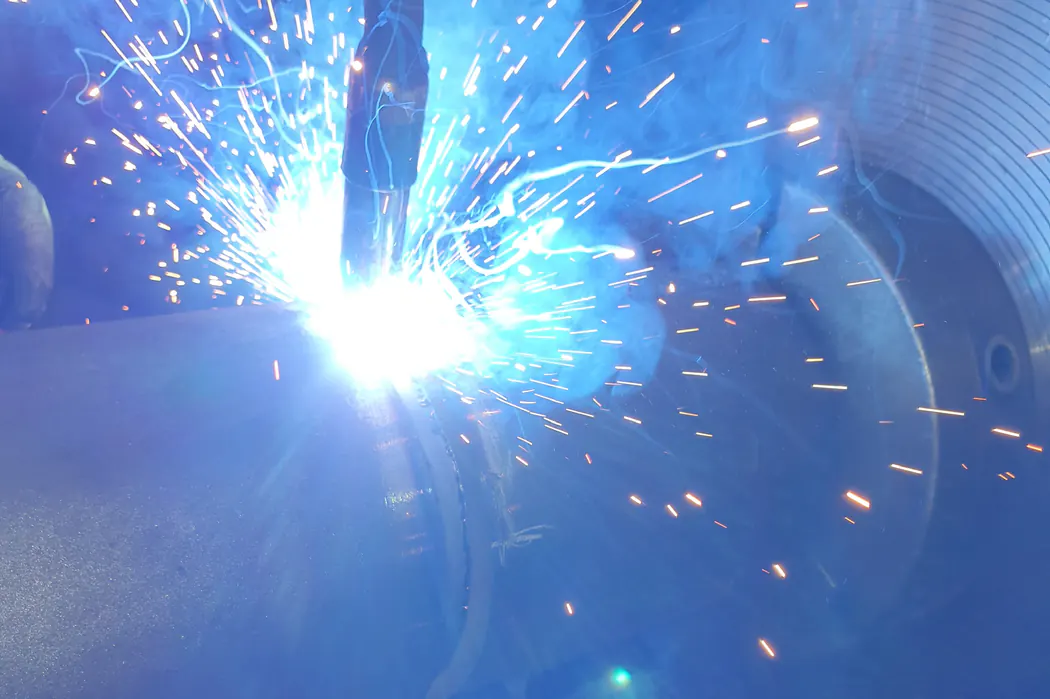
PWHT: post weld heat treatment explained
After welding, residual stresses remain in and around the joint, sometimes approaching the yield strength of the material. Combined with a hard microstructure, an aggressive service medium or heavy wall thicknesses, these stresses can cause cracking, dimensional instability or stress corrosion. Post weld heat treatment, PWHT, reduces those stresses and improves the microstructure of weld and heat affected zone.
PWHT is not a treatment to apply casually. It costs time and money, can degrade properties when done incorrectly, and is governed by strict rules. This article explains when PWHT is required, which temperatures and holding times apply, how to execute the treatment and what must be recorded.
What PWHT does to weld and material
During stress relieving, the structure or weld zone is heated in a controlled manner to below the transformation temperature of the steel, typically between 550 and 620 degrees Celsius for carbon and low alloy grades. At that temperature the yield strength temporarily drops, allowing residual stresses to relax through creep and local plastic deformation.
The treatment also has metallurgical effects: hard zones in the heat affected zone are tempered, hardness falls, diffusible hydrogen is almost completely removed and toughness usually improves. In some fine grain steels, or with excessive time or temperature, strength or toughness can instead deteriorate. PWHT is therefore always material specific.
When is PWHT required
Whether PWHT is mandatory follows from the applicable code, the wall thickness and the service conditions. Common cases:
- Pressure equipment under PED 2014/68/EU: product standards such as EN 13445 for vessels and EN 13480 for piping require PWHT above certain thickness limits per material group, as do ASME VIII and ASME B31.3
- Chromium molybdenum steels such as 13CrMo4-5 and 10CrMo9-10: PWHT is required almost regardless of thickness
- Structures at risk of stress corrosion cracking, for example in caustic, amine or wet H2S service: PWHT brings residual stresses below the critical threshold
- Machining to tight tolerances after welding: stress relieving prevents distortion during metal removal
Client specifications can be stricter than the code. Always review contract, code and material certificates together and record the conclusion in the welding quality plan.
Setting temperature and holding time
Soaking temperature and holding time follow from the material group and the code. Indicative values for common materials:
- Carbon and carbon manganese steel: 550 to 600 degrees Celsius
- 13CrMo4-5: roughly 630 to 700 degrees Celsius
- 10CrMo9-10: roughly 670 to 720 degrees Celsius
As a rule of thumb the holding time is 2 minutes per millimetre of wall thickness with a common minimum of 30 minutes, though code tables take precedence. Equally important is what is not allowed: for quenched and tempered steels the soaking temperature must remain well below the manufacturer's tempering temperature, otherwise strength drops below the guaranteed value. Obtain that tempering temperature from the certificate or the mill.
Execution: furnace or local PWHT
Furnace treatment is preferred because the entire structure is treated uniformly. Where the workpiece does not fit a furnace, local PWHT with electrical resistance mats or induction is the alternative, for example on field welds in piping. Requirements then apply to the width of the heated band and the insulation, so that temperature gradients stay controlled and no new stresses arise at the edge of the band.
Heating and cooling rates must also be controlled. Codes limit them above a certain temperature, often from 300 to 400 degrees Celsius, to a maximum that depends on wall thickness. Heating or cooling too fast introduces fresh stresses and can crack heavy sections.
PWHT and procedure qualification
Heat treatment is an essential variable in EN ISO 15614-1 and in ASME IX. A procedure qualified with PWHT does not cover production without it, and vice versa. The production soaking temperature must also stay within the qualified range. If production flexibility is needed, it must be built into the qualification strategy from the start.
Remember that PWHT determines the mechanical properties of the test weld: tensile, bend and impact tests are performed after the treatment. A consumable that performs well as welded may lose too much strength or toughness after soaking. When in doubt, consult the consumable manufacturer or seek independent welding engineering advice.
Records and demonstrability
PWHT is only worth anything if it is demonstrable. The records comprise at least:
- A heat treatment procedure stating heating rate, soaking temperature, holding time, cooling rate and thermocouple locations
- A continuous temperature record, the PWHT chart, with calibration evidence for recorder and thermocouples
- Traceability of which welds and workpieces were in which treatment batch
Inspection bodies scrutinise the chart: thermocouple number and position, attainment and maintenance of temperature, and actual rates. Hardness testing often follows as verification, together with the planned non destructive testing. Because PWHT can open or reveal cracks, final NDT is always scheduled after the treatment; independent NDT coordination helps fix that sequence and the acceptance criteria in the inspection and test plan.
Common PWHT mistakes
The same errors recur in practice. The heated band in local PWHT is too narrow, merely relocating the stresses. Thermocouples are fitted to the heating mat instead of the workpiece and record mat temperature. Quenched and tempered or thermomechanical steel is soaked above the permissible temperature and loses strength. Or a repair weld is not re treated although the code requires it.
Sequencing also goes wrong regularly: performing final NDT before soaking renders it worthless. Include PWHT in the inspection and test plan from the work preparation stage, with hold points before and after the treatment.
Frequently asked questions
PWHT, post weld heat treatment, is the umbrella term for any heat treatment after welding. Stress relieving is by far its most common form, so in everyday use the terms are treated as synonyms. Other post weld treatments exist, such as normalising or solution annealing of austenitic stainless steel, but these fall outside ordinary stress relieving.
That depends on the code and material group. For carbon steel, pressure equipment standards such as EN 13445 and ASME VIII set limits in the region of 30 to 38 millimetres, with options to raise them through additional preheat or toughness testing. For chromium molybdenum steels the limit is far lower or PWHT applies almost always. Always consult the governing code and the client specification.
Yes, the governing final examination belongs after the heat treatment. Existing flaws can grow or new ones form during soaking, for example reheat cracking in susceptible materials. Examinations performed before PWHT count at best as intermediate checks.
Vibratory treatment can partially reduce residual stresses and improve dimensional stability, but it has no metallurgical effect: hardness and hydrogen content remain unchanged. Where a code or client specification requires PWHT, vibration is not an equivalent alternative. It can be useful for purely dimensional applications without a code requirement.
More from the knowledge centre
Have a welding or QA/QC question?
Ask the DEHAAS Welding & Quality Assistant, have your case reviewed by a specialist, or call us directly.