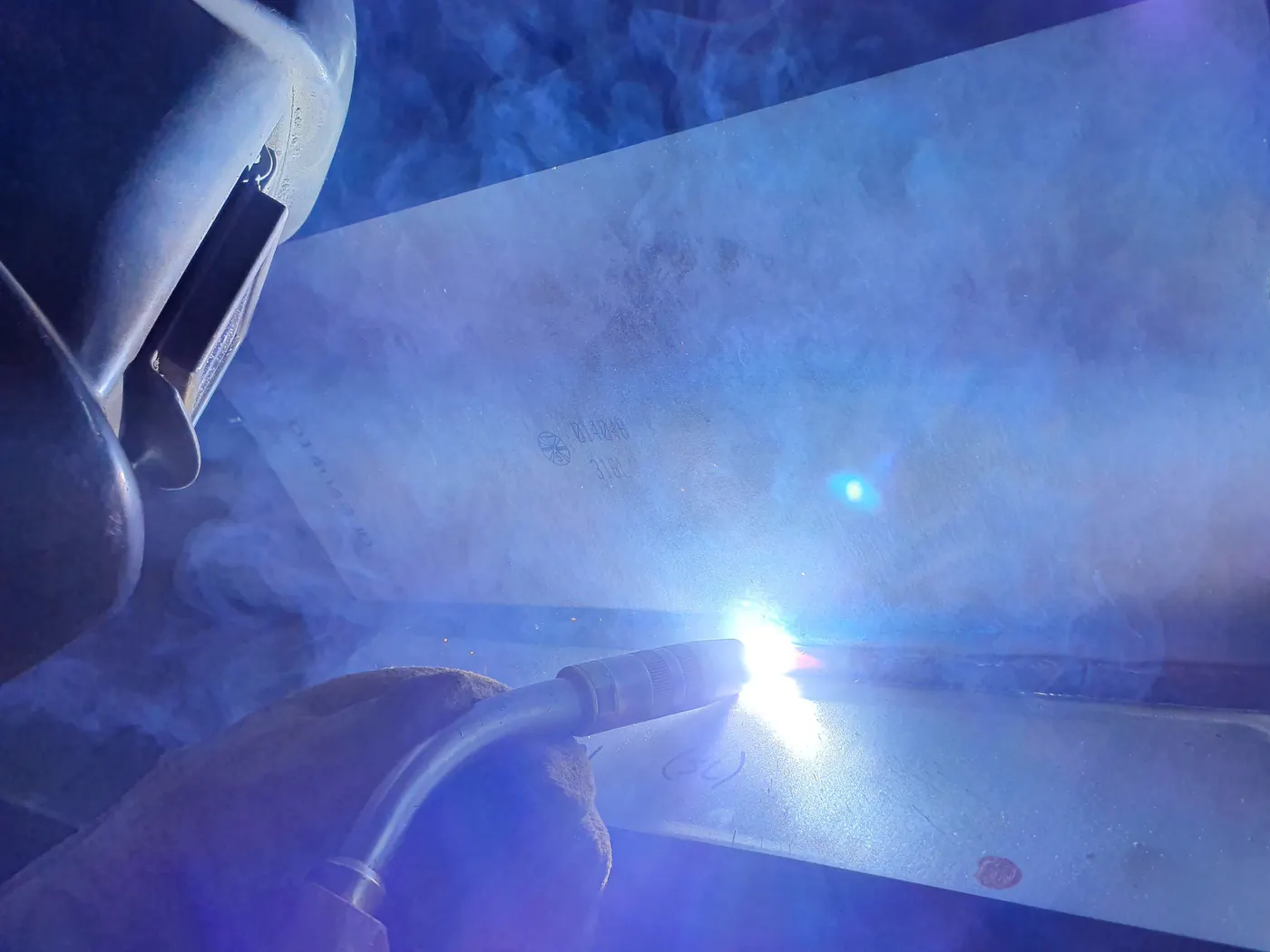
Dissimilar metal welds: stainless to carbon steel
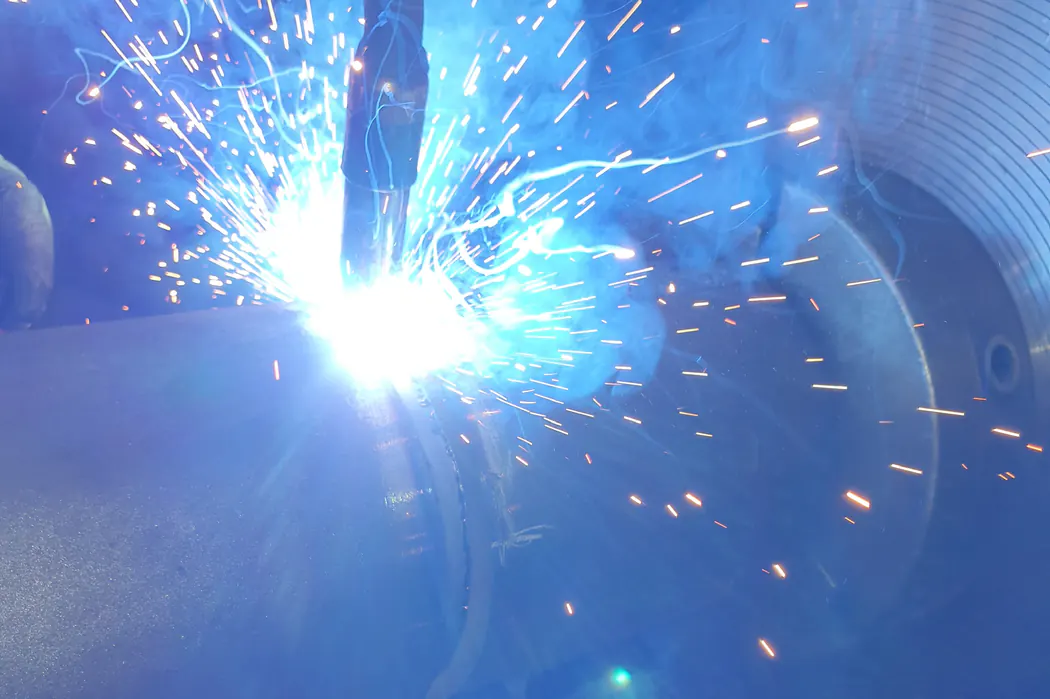
A joint between two different materials is not an ordinary weld with a different label. A transition zone forms with a composition found in neither material, and that zone determines whether the joint lasts twenty years or cracks within two.
This article covers the most common combination, austenitic stainless to carbon steel, and the principles that apply to other combinations too.
The problem of dilution
The weld metal mixes with both parent materials. Joining 316L to S355 means substantial dilution with carbon steel, lowering the chromium and nickel content of the weld metal. Drop too far and martensite forms instead of austenite, and martensite in this location is hard and crack sensitive.
The Schaeffler or DeLong diagram makes that visible: plotting the chromium and nickel equivalents of both parent materials and the filler shows where the weld metal lands. The target is the austenite plus ferrite field with a few percent ferrite.
The right filler metal
The standard choice is 309L or 309LMo. These are higher alloyed than 308L or 316L and therefore tolerate dilution with carbon steel without ending up in the martensite field. For most dissimilar joints at ambient temperature that is the safe, proven choice.
At higher service temperatures or in more severe service a nickel base filler is used, for example ERNiCrMo-3. That tolerates an even wider dilution margin and has an expansion coefficient between steel and stainless, which lowers thermal stress.
Carbon diffusion at temperature
At service temperatures above roughly 350 degrees, carbon migrates from the carbon steel into the chromium rich weld metal. That leaves a decarburised, soft zone on the steel side and a hard carbide rich band on the weld metal side. That combination is a classic fracture location.
A nickel base filler slows this considerably, because nickel has far less affinity for carbon than chromium. At high temperature that is the reason to accept the extra cost.
Expansion and residual stress
Austenitic stainless expands roughly one and a half times as much as carbon steel. In a joint that heats and cools, that means a recurring fluctuating stress precisely at the transition zone. Under cyclic operation that is often the real cause of failure, not the weld itself.
Limit that stress by keeping the transition away from stress concentrations, by choosing a nickel base filler and by allowing for expansion in the design. Under heavy cycling a transition piece is sometimes deliberately used.
Frequently asked questions
Preferably not. Dilution with carbon steel lowers the alloy content so far that martensite can form. 309L or 309LMo is the standard choice precisely because it tolerates dilution.
That depends on the carbon steel side. If it is heavy or higher alloyed steel, the preheat calculation of EN 1011-2 applies as usual. The stainless side needs no preheat, but the component is treated as a whole.
That is awkward. The stress relief temperature for carbon steel lies in the range where austenitic stainless sensitises and carbon diffusion accelerates. Heat treatment is therefore often undesirable; instead residual stress is limited through design and welding sequence.
Ultrasonic testing is difficult because of the coarse structure of austenitic weld metal, so radiography or low frequency phased array is the obvious route. Surface defects are found with penetrant testing, since magnetic testing does not work on the stainless side.
More from the knowledge centre
Have a welding or QA/QC question?
Ask the DEHAAS Welding & Quality Assistant, have your case reviewed by a specialist, or call us directly.