Submerged arc welding (121): productive and controllable
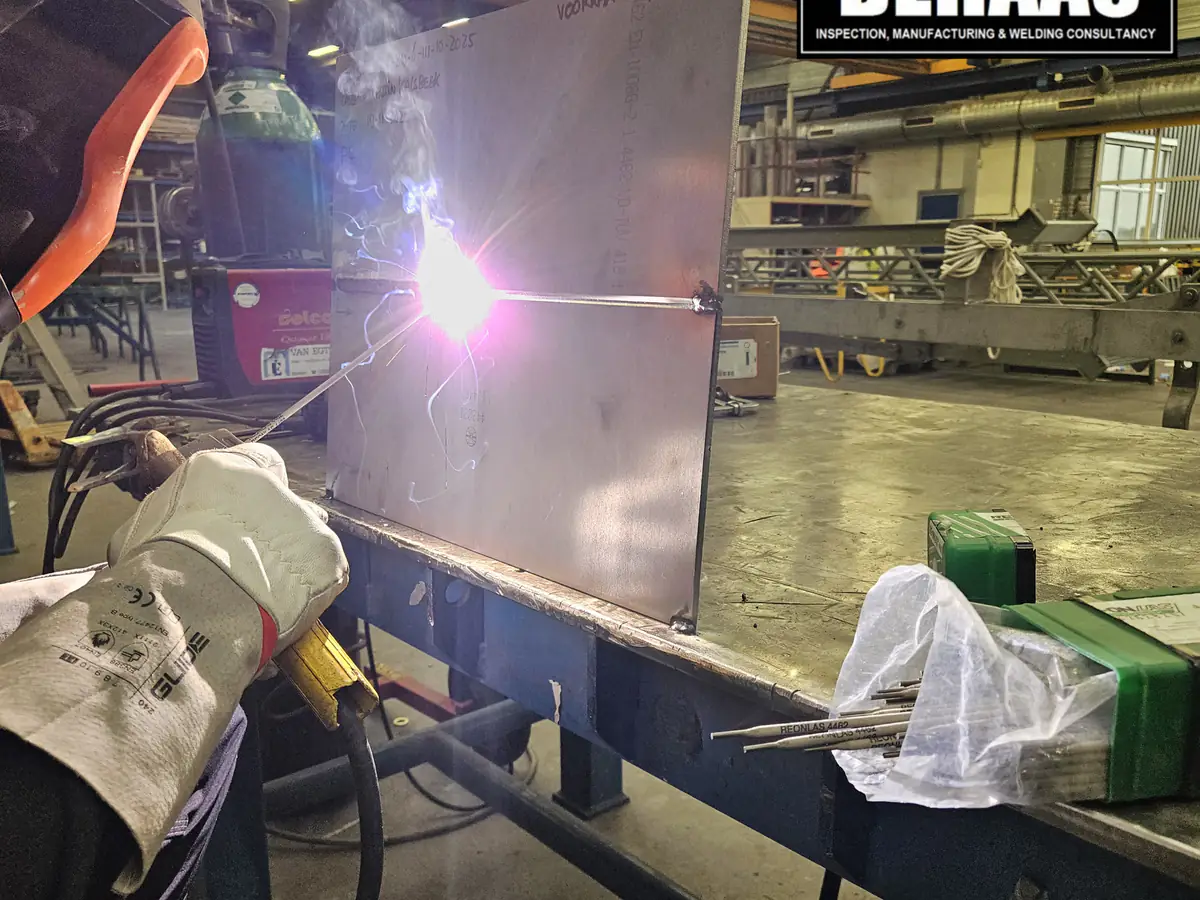
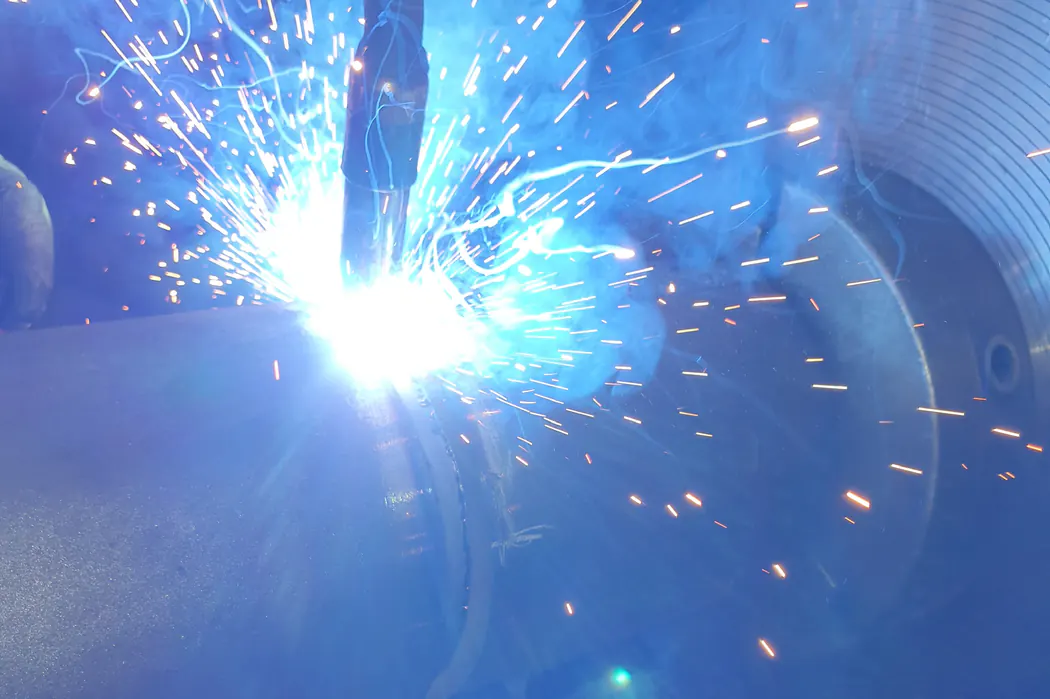
Submerged arc welding, ISO 4063 process 121 when using a single solid wire, is the most productive arc process for heavy wall steel. The arc burns out of sight beneath a layer of granular flux, which shields the weld, stabilises the arc and forms a slag that shapes the bead and slows cooling. The result is high deposition, deep penetration and a consistent appearance without spatter or significant fume.
This article explains where submerged arc welding fits, how to select the wire flux combination, which quality and toughness issues to watch and how procedures and operators are qualified.
How submerged arc welding works
A wire feeder drives the electrode continuously into the joint while flux is deposited just ahead of the arc. Beneath the flux, wire, parent metal and part of the flux melt. The molten flux forms a slag that is removed after cooling; unfused flux is recovered, sieved, dried and reused.
The process is always mechanised or automatic, using a tractor, gantry, column and boom or turning rolls. It runs on DC, AC or a combination in multi wire systems. Currents of 500 to 1000 amperes per wire give deep penetration, so thick plate can be welded in few passes.
High deposition: single wire, tandem and beyond
A single wire deposits roughly 5 to 12 kg per hour depending on diameter and current. Higher output comes from:
- Tandem and multi wire: two or more wires in one pool, each with its own power source
- Twin wire: two smaller wires through one contact tip
- Metal powder addition: extra deposition without a proportional increase in heat
- Cored wire: process 125, for specific alloys or higher output
Higher deposition almost always means higher heat input, which directly affects toughness and must stay within qualified limits.
Typical applications
- Longitudinal and circumferential seams in pressure vessels, boilers and storage tanks
- Built up girders and box sections with long fillet welds
- Tubulars and piles for offshore and wind, such as monopiles and transition pieces
- Shipbuilding and heavy plate joints
- Surfacing and cladding with corrosion or wear resistant layers
Cladding with a strip rather than a wire is strip cladding, process 122, which deposits a wide, flat layer of stainless steel or nickel alloy onto carbon steel in one pass, for example in reactors and heat exchangers. For even lower dilution, electroslag strip cladding, process 72, is used. In cladding, dilution is the critical parameter because it governs the chemistry and corrosion resistance of the overlay.
Selecting wire flux combinations
Wire and flux together determine the weld metal properties, so you always select a combination. Wires and combinations for non alloy and fine grain steels are classified to ISO 14171, fluxes to ISO 14174 and stainless wires to ISO 14343.
- Basic flux: high low temperature toughness and low oxygen, the standard for multi pass welds in pressure vessels and offshore structures
- Neutral flux: little manganese and silicon pick up, suitable for multi pass work
- Active flux: adds manganese and silicon, good for one or two pass welds on lightly rusted plate, but alloy content builds up and toughness drops over many passes
With active fluxes, alloy pick up rises with arc length, so voltage changes matter more than you might expect.
Quality considerations
- Solidification cracking: narrow, deep beads solidify from both sides towards the centre. Keep a generous width to depth ratio.
- Hydrogen: flux absorbs moisture. Store it dry, bake it as specified and remove fines and contamination when recycling.
- Slag inclusions: slag is harder to remove in narrow grooves and multi pass welds.
- Arc blow: on DC the magnetic field can deflect the arc, especially at joint ends. AC or repositioned earth clamps help.
- HAZ toughness: high heat input causes grain growth. Limit heat input per pass where impact requirements are demanding.
On circumferential seams, position the wire slightly past top dead centre, against the direction of rotation, so the pool does not run away. For an overview of defects see weld defects and their causes.
Qualifying procedures and operators
Procedures are qualified to EN ISO 15614-1. Key variables include the wire flux combination, number of wires, type of current, heat input and preheat and interpass temperature. Changing from single to multi wire, or vice versa, requires a new qualification, and a different flux type or manufacturer needs careful assessment, particularly with impact requirements.
Because the process is mechanised or automatic, operators and weld setters are qualified to ISO 14732, not ISO 9606-1. PED 2014/68/EU and ASME IX add their own requirements. When commissioning a submerged arc installation or optimising existing procedures, welding engineering and coordination keeps productivity and qualification aligned.
Frequently asked questions
Mainly flat (PA) and horizontal fillet (PB), since the flux must stay on the joint. With flux support, horizontal welds on a vertical wall are possible, for example on the girth seams of storage tanks.
Yes, unfused flux can be reused provided it is sieved, free of slag, dust and contamination, and kept dry. Preferably blend recovered flux with new flux and follow the manufacturer's guidance. Using crushed slag as flux is a separate technique requiring its own qualification.
From about 5 mm it works well. On thinner material burn through becomes likely and the productivity gain is limited, so MAG or TIG are usually better choices.
Process 121 uses a single solid wire electrode, process 122 a strip electrode. Strip welding is used mainly for cladding and surfacing, as a wide strip gives a flat layer with low dilution.
More from the knowledge centre
Have a welding or QA/QC question?
Ask the DEHAAS Welding & Quality Assistant, have your case reviewed by a specialist, or call us directly.