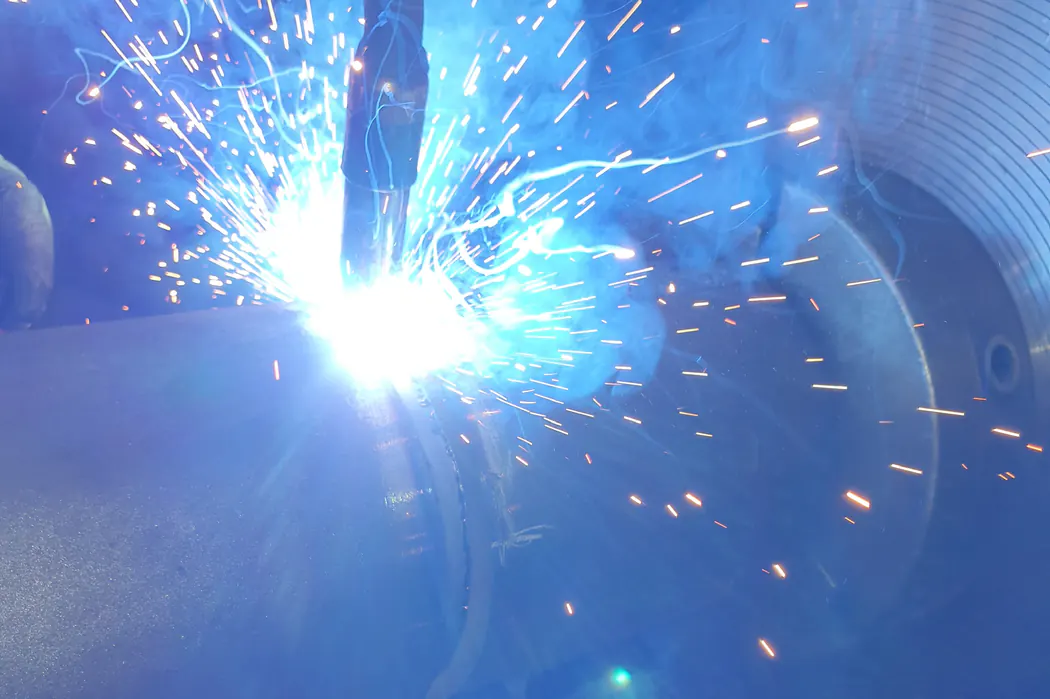
Robot welding: qualification and control
A welding robot delivers a consistency manual welding cannot match: the same current, the same speed, the same torch angle, a thousand times over. That repeatability is exactly why robot welding is attractive, and also why an error repeats itself a thousand times.
This article covers how robot welding is qualified and which controls genuinely secure that repeatability.
Qualifying the procedure and the operator
Procedure qualification runs through EN ISO 15614-1 as usual, with the process designated mechanised or automatic. The coupon is welded by the robot using the parameters that production will use.
The person operating the robot is not a welder but an operator, qualified to ISO 14732. That qualification tests not manual dexterity but the ability to set up, monitor and recognise deviations. See operator qualification.
The programme is the document
In manual welding the WPS is the governing document; in robot welding it is the programme. A changed programme is therefore a changed welding procedure, even where the parameters on paper stay the same.
Control programme versions as you would documents: a version number, a reason for change, an approval and a link to the WPS. In practice this is the weakest point of many robot cells: anyone can adjust and nobody knows which version was approved.
What disturbs repeatability
The robot repeats its motion exactly, but the workpiece does not. Component tolerances, jig wear, positional variation after tacking and distortion during welding mean the joint is not always in the same place.
Seam tracking systems address that, using a touch sensor, the wire as a sensor, or a laser sensor following the joint during welding. Without such a system, tight tolerances on supply and jig are the only way to secure quality.
Production monitoring
Modern installations record current, voltage, wire feed speed and gas flow per weld. That data is evidence that welding stayed within parameters and makes it possible to detect deviation before a hundred parts have been made.
Define which limits apply and what happens when they are exceeded: stop, mark or assess afterwards. Without that agreement the recording is a file nobody opens. Combine it with periodic checks of nozzle, contact tip and wire feed.
Frequently asked questions
Procedure qualification is tied to the manufacturer and the procedure, not to a specific machine, provided the installations are equivalent. The operator must be qualified and the installation must be demonstrably capable of achieving the parameters.
Check whether the change stays within the qualified parameters. If the path is unchanged and only speed varies within range, it is a programme revision. If welding sequence or position changes materially, the WPS must be revised and sometimes requalified.
No, but without it, component and fixturing tolerances must be tight enough that the joint always falls within the torch's reach. With variable supply, seam tracking is usually cheaper than tighter tolerances.
Common practice is a first-off check at every start-up, every programme change and after torch maintenance, supplemented by sampling through the run. Record that frequency in the quality plan.
More from the knowledge centre
Have a welding or QA/QC question?
Ask the DEHAAS Welding & Quality Assistant, have your case reviewed by a specialist, or call us directly.