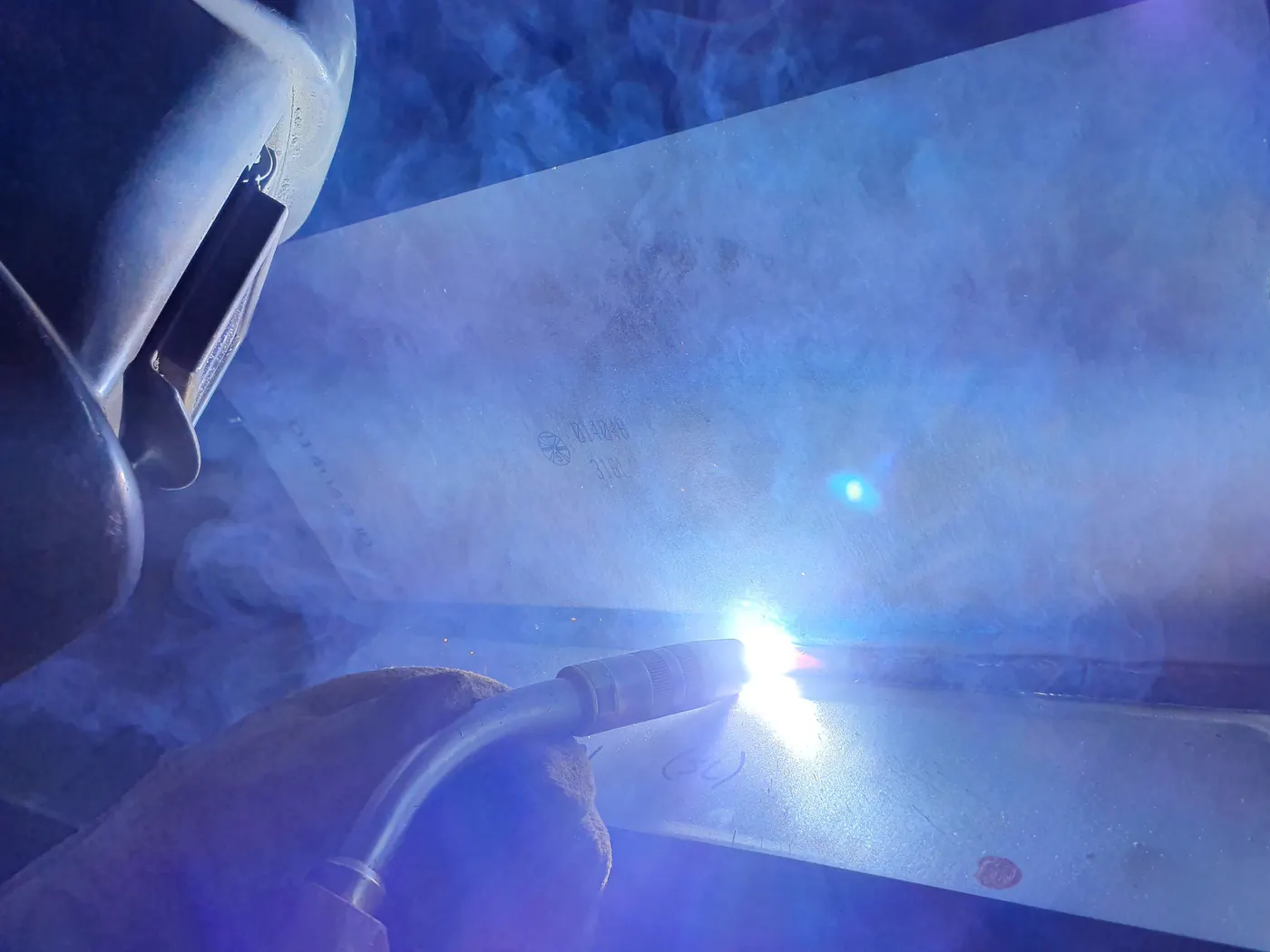
Welding aluminium: 5083 and 6082
Aluminium is not a difficult material, but it is an unforgiving one. Follow the rules and you get sound, low porosity welds; ignore them and you get porosity, lack of fusion and a joint substantially weaker than the plate around it. That last point is not a defect but physics: in the heat affected zone the strengthening mechanism that gave the material its properties disappears, and the designer has to allow for that from the start.
This article covers the two alloys most commonly welded in Europe, 5083 and 6082, with the practical points that make the difference: the oxide film, hydrogen, filler selection, HAZ softening and the framework of EN 1090-3 and EN ISO 15614-2.
5083 and 6082: two very different alloys
5083 is an aluminium magnesium alloy from the 5000 series. It is not heat treatable: its strength comes from magnesium in solution and from cold work. 5083 welds excellently, resists seawater very well and is therefore widely used in shipbuilding, tank fabrication and offshore work.
6082 is an aluminium magnesium silicon alloy from the 6000 series and is heat treatable. In the T6 condition it is solution treated, quenched and artificially aged, which makes it considerably stronger than 5083. Welding destroys that ageing locally. On top of that, 6082 is prone to hot cracking if welded with unsuitable filler.
The practical consequence: on 5083 the weld causes little more than mild softening, while on 6082 the weld can halve local strength. That is no reason to avoid welding 6082, but every reason to adapt the design and keep welds away from the most heavily loaded sections.
The oxide film is the biggest problem
Aluminium forms a tenacious oxide film within seconds. That film melts only above 2000 degrees Celsius, while the aluminium beneath it turns liquid at around 660 degrees. Weld over an oxide film and you leave a non-melting membrane between weld metal and parent material: a lack of fusion defect that is hard to find with ultrasonics and invisible to the eye.
Remove the oxide mechanically immediately before welding, with a stainless brush used only on aluminium, or with a scraper. Degrease first, because brushing over grease drives the grease into the pores. Weld within a few hours of cleaning; the longer you wait, the thicker the new oxide.
In GTAW, alternating current helps: the positive half cycle breaks up the oxide through cathodic cleaning. In GMAW the positive electrode provides that effect continuously. Direct current electrode negative gives deeper penetration in GTAW but no cleaning action, so it only works with helium and an excellently prepared joint.
Preventing hydrogen porosity
Liquid aluminium dissolves roughly twenty times more hydrogen than solid aluminium. On solidification that hydrogen is released and forms round pores. This is by far the most common cause of rejection in aluminium welding.
Hydrogen comes from moisture: condensation on cold material, moisture in the oxide film, grease, cutting oil, a leaking gas hose or a cylinder with a high dew point. The answer is dry, clean work. Let cold material reach shop temperature, degrease with a suitable solvent, brush, and check the gas line for leaks. Use welding grade argon, not technical grade.
A second source is the wire itself. Aluminium wire left open in the shop for months picks up moisture and dirt. Keep the spool in a sealed bag and use a PTFE or plastic liner: in a steel liner the soft wire abrades and contaminates itself with steel particles.
Filler metal and hot cracking
For 5083 you almost always use 5183 or 5356, with 5183 slightly higher alloyed and therefore closer to parent metal strength. For seawater service 5183 is the standard choice.
For 6082 it is more delicate. Welding 6000 series with filler from the same series, or autogenously, carries a high risk of hot cracking because the solidification range of the alloy is unfavourable. So you select 5356 when strength and toughness matter, or 4043 when formability and bead appearance matter and the structure allows it. 4043 is silicon bearing, less crack sensitive but lower in toughness, and visibly darker after anodising.
When joining 5000 series to 6000 series, 5356 is usually the safe choice. Record that choice in the WPS rather than leaving it to the shop floor: a welder reaching for whatever spool is on the bench changes the structural properties in thirty seconds.
Strength loss in the heat affected zone
In 6082-T6 the precipitation structure disappears in a zone several centimetres wide around the weld. Proof strength there drops from roughly 260 N/mm2 to 110 to 125 N/mm2. EN 1999-1-1, the Eurocode for aluminium structures, therefore applies a HAZ softening factor, and the designer must use it.
In 5083 in the H111 or O condition the loss is small, because strength does not come from ageing. In cold worked tempers such as H116 or H321 the cold work is indeed lost in the HAZ, with a corresponding reduction.
On 6082 the properties can be recovered by solution treating and ageing after welding, but that means an oven cycle for the whole structure and brings distortion. In practice it is almost never done; designing with the reduced value is the normal route.
Standards and qualification
Execution of load bearing aluminium structures falls under EN 1090-3, the aluminium counterpart of EN 1090-2. Like the steel version it works with execution classes EXC1 to EXC4 and with quality requirements to EN ISO 3834. See EN 1090 execution classes.
Procedure qualification for aluminium runs through EN ISO 15614-2, a separate part that deliberately differs from part 1 on material groups and thickness ranges. Aluminium alloys are grouped 21 to 26 under ISO/TR 15608. Welder qualification runs through EN ISO 9606-2. Imperfection limits are given in EN ISO 10042, the aluminium equivalent of ISO 5817, also with levels B, C and D.
Frequently asked questions
No. Aluminium must be welded under pure inert gas, so argon or an argon helium mixture. CO2 or oxygen in the gas immediately oxidises the weld pool and gives a porous, dirty weld. Adding helium raises heat input and is useful on heavy sections.
Almost always moisture or grease. Check whether the material was at shop temperature, whether condensation was present, whether the joint was degreased and brushed, and whether the gas hose leaks. A hose drawing in air gives exactly the same picture as insufficient gas flow.
Usually not. Gentle preheat to 80 or 100 degrees can improve fusion on heavy sections, but more than roughly 120 degrees harms 6000 series material because it further degrades the ageing. On high magnesium 5083, prolonged exposure above 65 degrees is discouraged because of stress corrosion sensitivity.
Aluminium wire is soft and buckles easily. Use a larger diameter than you would for steel, often 1.2 mm instead of 1.0 mm, with a push pull torch or spool gun over longer distances. Drive rolls should be U grooved and pressure light: too much pressure flattens the wire and causes bird nesting.
Preferably not. Aluminium loads the disc, and a disc previously used on steel embeds iron particles in the surface. Use discs intended for aluminium, or milling tools, and keep them separate from steel work.
More from the knowledge centre
Have a welding or QA/QC question?
Ask the DEHAAS Welding & Quality Assistant, have your case reviewed by a specialist, or call us directly.