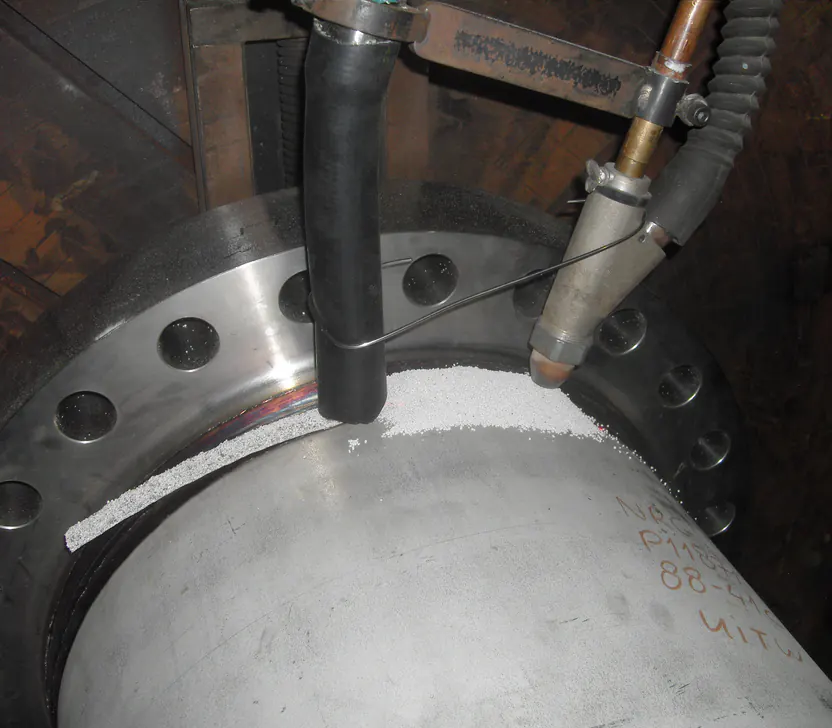
Welding austenitic stainless steel: 304 and 316
Austenitic stainless steel is the most widely welded stainless material in the world, and at the same time the material that causes the most field problems. It looks easy to weld: it is tough, it does not harden and it needs no preheat. Exactly for that reason it is often treated like carbon steel, and that is where it goes wrong. Its thermal conductivity is roughly a third of steel, its expansion one and a half times higher, and its corrosion resistance depends entirely on a chromium oxide layer that welding locally destroys.
This article covers what happens inside 304 and 316 during welding, how to select filler metal, how to control heat input and interpass temperature, why backing gas on full penetration joints is not optional, and how to restore corrosion resistance after welding.
What separates 304 from 316
The two grades differ in essence on one point: 316 contains roughly 2 to 3 percent molybdenum, 304 does not. That molybdenum substantially increases resistance to pitting corrosion in chloride environments. In seawater, brine, swimming pool atmospheres and many process fluids it is the difference between an installation that lasts twenty years and one that pits within two.
Both grades are austenitic: at room temperature the lattice is face centred cubic, which makes them non-magnetic, extremely tough and not hardenable. The L variants 304L and 316L have reduced carbon, maximum 0.030 percent instead of 0.08 percent. For welded work that is not a detail but the default choice, for reasons explained below.
Under EN 10088-2 the typical designations are 1.4301 for 304, 1.4307 for 304L, 1.4401 for 316 and 1.4404 for 316L. Both naming systems appear on drawings and purchase orders, so always check the material certificate when in doubt: AISI designation and material number are regularly mixed up on the shop floor.
Chromium carbide precipitation and sensitisation
When austenitic stainless steel dwells between roughly 450 and 850 degrees Celsius, carbon and chromium combine at the grain boundaries to form chromium carbides. That leaves a chromium depleted zone along those boundaries. Once the local chromium content drops below roughly 10.5 percent, that zone is no longer stainless and intergranular corrosion follows. The material is then sensitised.
The heat affected zone next to a weld passes through that temperature range by definition. The longer it dwells there, the more carbides form. Three measures prevent the problem: select an L grade so there is too little carbon available; keep heat input low so the dwell time is short; and limit interpass temperature.
In stabilised grades such as 321 (titanium) and 347 (niobium) the stabilising element ties up the carbon before chromium gets the chance. Those grades are mainly used at elevated service temperatures. For general structural and equipment work an L grade is simpler and cheaper.
Selecting filler metal
The rule of thumb is that filler is slightly higher alloyed than the parent material, so the weld still complies after dilution. For 304 and 304L that is 308L, for 316 and 316L it is 316L. Use 308L on 316 and you lose the molybdenum in the weld, making that weld the weak point in a chloride environment.
Filler metal for austenitic stainless is deliberately formulated so the weld metal contains a small amount of delta ferrite, typically 3 to 10 FN. Those few percent of ferrite prevent hot cracking in the solidifying weld metal. Fully austenitic weld metal is crack sensitive. Ferrite content is measured with a ferritescope; pressure equipment and cryogenic work regularly specify both a minimum against hot cracking and a maximum for toughness and magnetism. See our article on ferrite measurement.
Watch the product form as well. Use solid rods for GTAW, solid wire for GMAW, and check the position rating for flux cored wire. Store stainless filler separately from steel and use dedicated tools, brushes and grinding discs. Iron particles pressed into the surface will rust and then attack the stainless around them.
Heat input, interpass and distortion
The coefficient of thermal expansion of austenitic stainless is roughly 16 to 17 micrometres per metre per degree against roughly 12 for carbon steel, while thermal conductivity is far lower. That combination keeps heat local while the material wants to expand strongly. The result is more shrinkage and more distortion than steel practice would suggest.
Keep heat input low, in practice often below 1.5 kJ/mm, and cap interpass temperature at around 150 degrees Celsius. Actually measure it, with a contact thermometer or temperature indicating crayon; a hand on the plate is not a measurement. How to calculate heat input is covered in calculating heat input.
For distortion the same techniques apply as for steel, but more strictly: close tack spacing, balanced welding, back step sequences on long seams, solid fixturing and as little weld metal as the design allows. See controlling weld distortion for the full approach.
Backing gas on full penetration welds
On a full penetration weld the root side sees air while the material is still above 300 degrees. Oxygen then burns the surface chromium into a thick oxide layer. That layer is not merely unsightly, it is chromium depleted: corrosion resistance on the root side is compromised. In food, pharmaceutical and process piping that is unacceptable.
The remedy is purging the root side with backing gas: argon, nitrogen or a nitrogen hydrogen mixture. Purge until residual oxygen is below the specified limit. General process piping often works to 0.5 percent, while titanium grade requirements and highly critical service work towards 50 ppm. Measure with an oxygen analyser in the return line rather than relying on purge time alone.
Root colour is a direct indicator: silver white or light straw is good, dark blue is borderline, grey or black with a powdery oxide is rejectable. Many specifications, including AWS D18.2 for the food industry, attach a colour chart to this.
Post-weld treatment: pickling and passivation
After welding the surface around the weld is discoloured, and that heat tint is a chromium depleted oxide. Brushing with a stainless brush makes it look tidier but does not fully restore corrosion resistance. For critical service, pickle the weld: pickling paste, spray or an immersion bath etches away the affected layer.
After pickling, passivate so the chromium oxide film reforms evenly. In practice this is often a combined step, or achieved by exposing clean dry material to air. Electrolytic cleaning is an alternative that works locally and without aggressive acids, but it removes heavy oxide scale less effectively.
The full method, including the safety aspects of hydrofluoric pickling paste, is covered in stainless heat tint, pickling and passivation.
Qualification and standards framework
For procedure qualification, austenitic stainless falls under EN ISO 15614-1 in Europe and under group 8 of the ISO/TR 15608 material grouping. Qualifying on 316L does not automatically cover every other group 8 grade within the rules of the standard, so check the range before you cut a test coupon. See WPQR validity range.
For welder qualification EN ISO 9606-1 applies with the relevant material group. Note that qualifying on austenitic material does not automatically cover carbon steel or the other way around. For pressure equipment the PED adds a layer, with filler metal and procedure approved by a notified body. See PED and welding.
Frequently asked questions
Technically yes, and the weld is not worse for it, because 316L is higher alloyed. It simply costs more, and some specifications require weld metal to match the parent material. The reverse, welding 316 with 308L, is a genuine problem: the weld then lacks molybdenum and corrodes before the plate around it.
No. Austenitic stainless does not harden and is not susceptible to hydrogen cracking, so preheat serves no purpose. Extra heat in fact worsens distortion and carbide precipitation. Only on very heavy sections, or with moisture on the surface, is gentle warming above the dew point useful.
That is the delta ferrite in the weld metal, and it belongs there. A few FN of ferrite prevents hot cracking and makes the weld slightly magnetic. Strong magnetic response in the parent material can indicate deformation martensite from cold work, or a wrongly supplied grade.
That depends on the specification. Silver white to light straw is almost always accepted, dark blue often only outside process critical zones, and grey or black with a flaky oxide almost never. Agree the limit in advance using a colour chart and the discussion afterwards disappears.
No. A brush used on carbon steel presses iron particles into the stainless surface. Those particles rust and cause local pitting in the stainless. Use dedicated stainless brushes, separate grinding discs and a separate work area or bench.
More from the knowledge centre
Have a welding or QA/QC question?
Ask the DEHAAS Welding & Quality Assistant, have your case reviewed by a specialist, or call us directly.