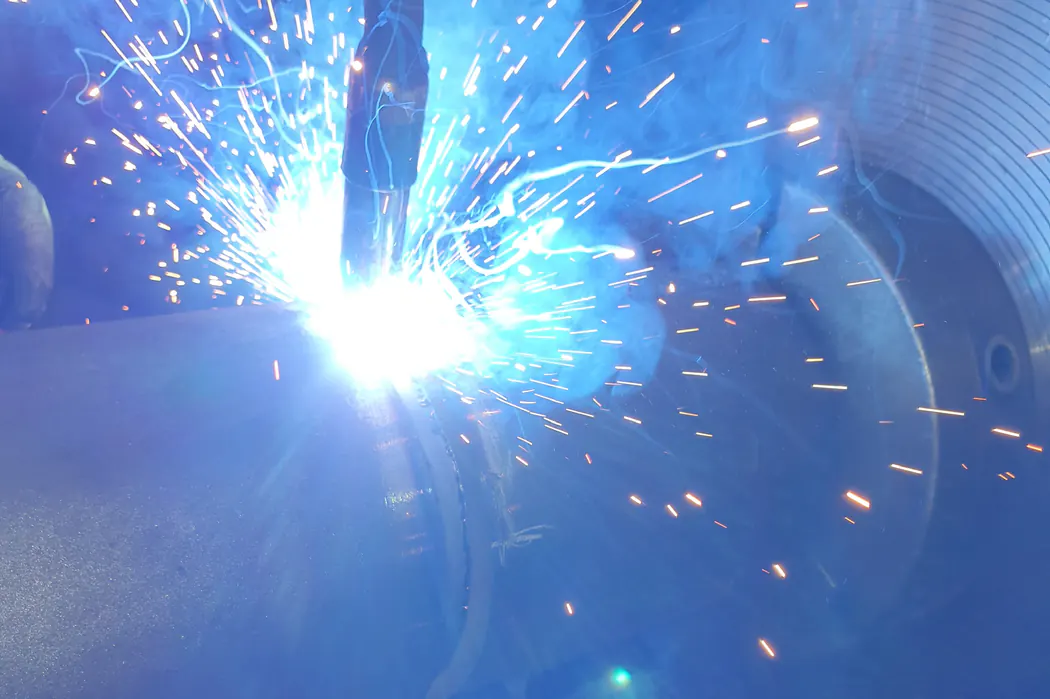
MAG welding process 135 and cored wire processes 136 and 138
Process 135, metal active gas welding with solid wire, is the workhorse of steel construction and machine building. A continuously fed wire electrode melts in an arc under an active shielding gas, making the process fast, productive and easy to mechanise. Closely related are process 136, MAG welding with flux cored wire, and process 138, MAG welding with metal cored wire.
Because MAG welding is so accessible, its limitations are often underestimated. This article explains the metal transfer modes, which shielding gas suits which job, the strengths and pitfalls of 135, 136 and 138, and what to watch when qualifying procedures and welders.
How process 135 works
A wire feeder pushes solid wire through the torch cable to the contact tip, where it picks up current. The arc between wire and workpiece melts both the wire and the parent metal, while shielding gas flowing through the nozzle keeps oxygen and nitrogen away from the weld pool. The term active refers to the CO2 or oxygen content of the gas, which takes part in the arc and pool reactions.
MAG welding is almost always carried out on DC with the wire positive. Current follows from wire feed speed, voltage sets the arc length, and together with the electrode extension they determine how metal transfers across the arc.
Metal transfer modes: short arc, spray and pulse
The transfer mode governs penetration, positional capability and defect sensitivity.
- Short circuit transfer: low current and voltage, the wire repeatedly touches the pool. Low heat, suited to thin sheet, root runs and positional work, but with a real risk of lack of fusion on thicker sections.
- Globular transfer: large, irregular droplets and heavy spatter, a range best avoided.
- Spray transfer: high current, fine droplets without short circuits. Deep penetration and high deposition, but limited to flat and horizontal positions and argon rich gases.
- Pulsed transfer: current alternates between background and peak, detaching one droplet per pulse. Low spatter and controllable, also in position and on stainless steel.
Record the transfer mode in the WPS, as a qualification in short arc does not automatically cover spray or pulse, and vice versa.
Shielding gases for MAG welding
Shielding gases are classified to ISO 14175. The choice affects arc stability, penetration, spatter and mechanical properties.
- M21, argon with 15 to 25 percent CO2: the standard for carbon and low alloy steels, suitable for all transfer modes
- C1, pure CO2: cheap with deep penetration, but more spatter and no true spray transfer
- M20 and M12, argon with low CO2: a smoother arc, M12 being common for stainless steel
- M13, argon with a small oxygen addition: stable spray on stainless steel and thin sheet
Excess CO2 on stainless steel raises the carbon content of the weld metal. For cored wires the gas is part of the wire classification: a wire classified with M21 behaves differently under C1, affecting strength and toughness.
Cored wire: processes 136 and 138
A cored wire is a metal tube filled with slag formers, alloying elements or metal powder. In process 136 the core is rutile or basic. Rutile flux cored wires form a fast freezing slag that supports the pool, allowing high current and high deposition in all positions. Basic flux cored wires offer better toughness and low hydrogen but are harder to handle.
Process 138 uses metal cored wire, which produces almost no slag, broad penetration and high deposition, making it ideal for mechanised and robotic multi pass welding. Cored wires for non alloy steels are classified to ISO 17632, solid wires to ISO 14341 and stainless wires to ISO 14343.
Strengths of MAG welding
- High travel speed and deposition compared with MMA and TIG
- No electrode changes, so long uninterrupted welds
- Easy to mechanise and automate, from carriage to robot cell
- Wide range, from thin sheet to heavy wall fabrication
- With solid wire, no slag and little interpass cleaning
This makes process 135 the natural choice for structures to EN 1090-2, machine frames and shop fabrication.
Common pitfalls with processes 135 and 136
- Lack of fusion: typically short arc on thick material, excessive travel speed or poor torch angle. Often invisible on the surface and only found by volumetric testing.
- Porosity: draughts, a clogged or distant nozzle, incorrect gas flow, or dirt and moisture on the joint.
- Slag inclusions with 136: inadequate interpass cleaning.
- Wire feed problems: worn contact tips, kinked cables and wrong drive rolls cause an unstable arc.
- Hydrogen: some rutile cored wires pick up moisture. Specify low hydrogen wire such as H5 for crack sensitive steels.
For an overview of defects and their causes, see our article on weld defects.
Qualification and parameters in the WPS
A WPS for process 135, 136 or 138 should state at least the consumable, shielding gas and flow rate, transfer mode, current, voltage, wire feed speed, travel speed, and preheat and interpass temperature. Procedures are qualified to EN ISO 15614-1, welders to ISO 9606-1, and operators of mechanised or robotic equipment to ISO 14732.
Current, voltage and travel speed together determine heat input, which belongs in every WPS where toughness or hardness matter. Independent welding engineering support can review your process choice or existing procedures to balance productivity and quality.
Frequently asked questions
The shielding gas. MIG, process 131, uses an inert gas such as argon or argon helium and is mainly used for aluminium and copper. MAG, process 135, uses an active gas containing CO2 or oxygen and is the standard for carbon and stainless steels.
Cored wire pays off with extensive positional welding at high deposition, heavy wall work and demanding toughness requirements. Rutile flux cored wire is easier to use in position than solid wire in spray mode, at the cost of higher wire prices and slag removal.
Only if the gas shield is protected. Even moderate wind quickly causes porosity. Outdoors you need screens or a shelter, or you switch to self shielded cored wire (process 114) or MMA welding.
Under ISO 9606-1, solid wire (135) qualifies metal cored wire (138) and vice versa. Flux cored wire (136) follows separate rules. Always check the range of qualification tables in the standard and the entries on the certificate.
More from the knowledge centre
Have a welding or QA/QC question?
Ask the DEHAAS Welding & Quality Assistant, have your case reviewed by a specialist, or call us directly.