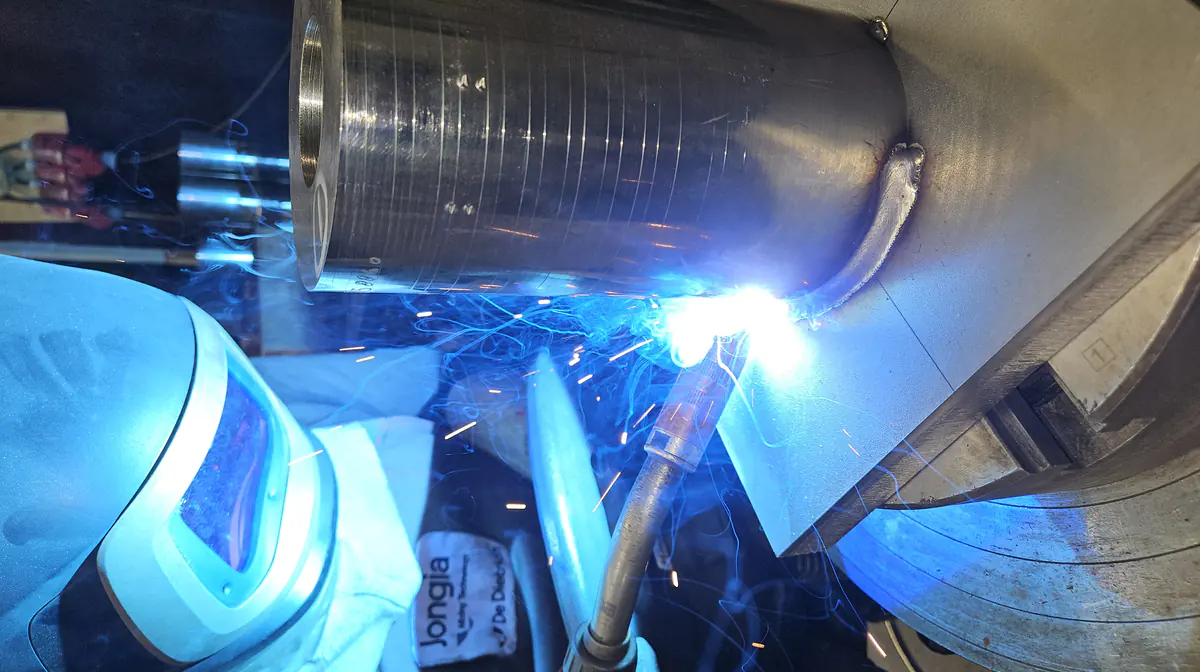
Welder qualification to ISO 9606-1
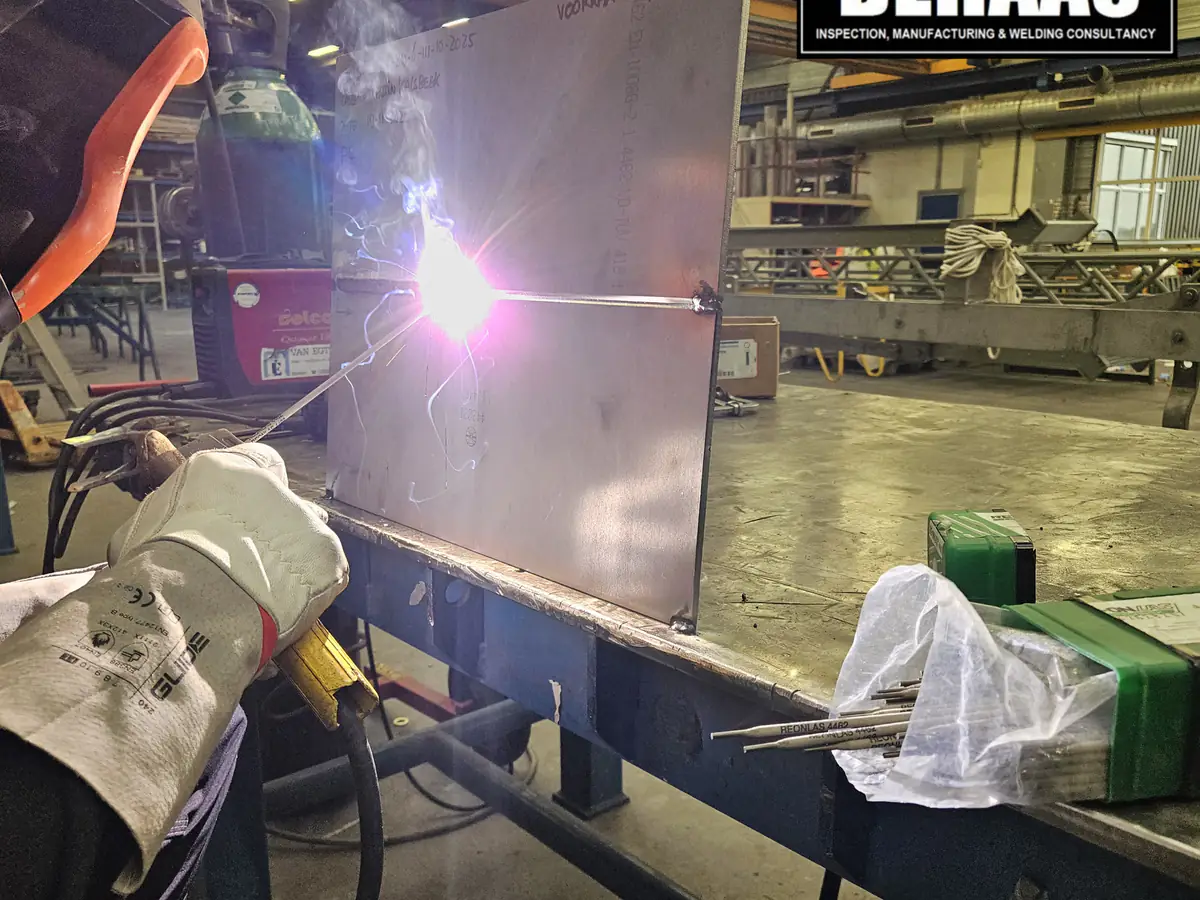
A qualified welding procedure is worthless without qualified welders. ISO 9606-1 governs the qualification testing of welders for manual and partly mechanised fusion welding of steel: which test a welder must pass, which variables define the range of qualification and how the test piece is assessed. For clients and certification bodies, the welder's certificate is the proof that the person holding the torch masters the trade.
This article explains the structure of ISO 9606-1: the essential variables, the ranges of qualification, the test piece requirements and how the examination itself proceeds. That helps you plan qualifications properly and avoid certificates that fall just short of the actual work. Prolongation of certificates is covered separately in our article on revalidating welder qualifications.
What ISO 9606-1 covers, and what it does not
ISO 9606-1 tests the welder's skill: can this person produce a sound weld with the given process in the given position? The standard applies to fusion welding of steel with manual and partly mechanised processes, such as 111 (MMA), 135 and 136 (MAG) and 141 (TIG).
It explicitly does not cover the welding procedure itself; that is qualified to EN ISO 15614-1 and recorded in a WPQR. The two tracks run in parallel: a project requires qualified procedures and qualified welders. Fully mechanised and automatic welding also falls outside ISO 9606-1; that is the domain of ISO 14732, described in our article on operator qualification to ISO 14732. Other metals have their own parts of the 9606 series, such as part 2 for aluminium.
The essential variables that define the range
The certificate does not cover all welding, only a range defined by essential variables. The main ones are:
- Welding process: each process is qualified separately in principle.
- Product form: plate or pipe.
- Weld type: butt weld or fillet weld; one covers the other only to a limited extent.
- Filler material group: ISO 9606-1 classifies by filler metal (groups FM1 to FM6), not by parent material.
- Thickness and pipe diameter of the test piece.
- Welding position: a test in PA does not cover PF or PE; harder positions cover easier ones.
- Weld details: single-sided or double-sided, with or without backing.
Tables in the standard state what each test covers. Choosing wisely pays off: a test in a difficult position on pipe covers much of the simpler work as well.
The test piece: dimensions and execution
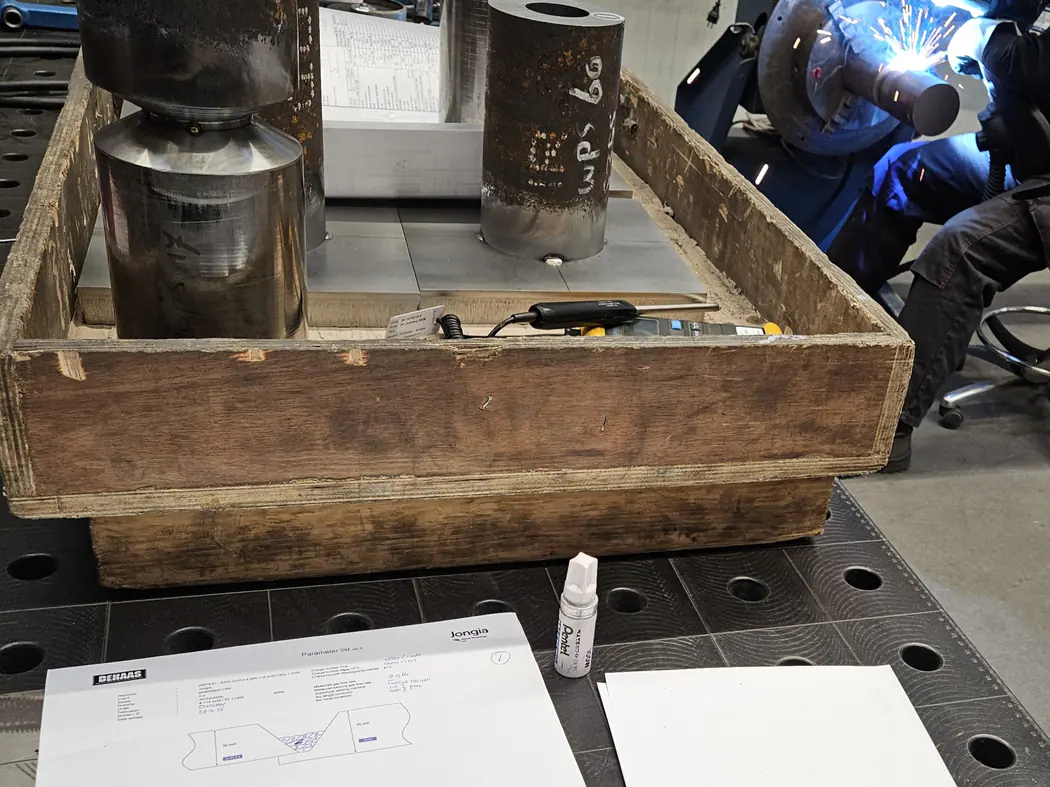
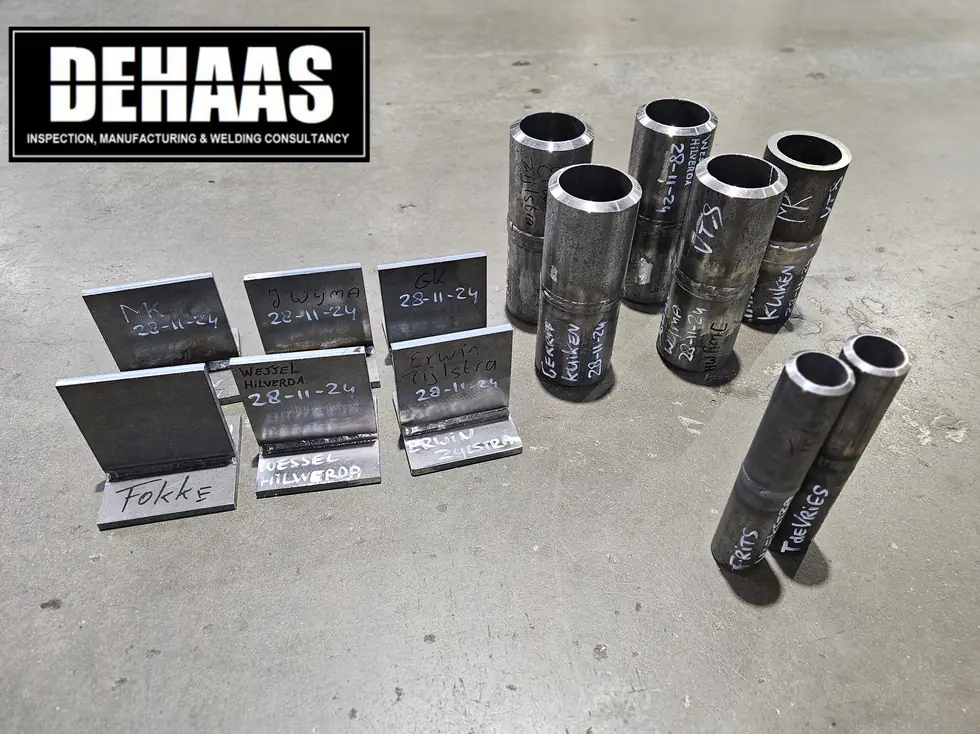
The standard prescribes test pieces per product form and weld type, including minimum dimensions. On plate, a butt or fillet weld is made over a specified length; on pipe, a circumferential weld on a pipe of a given diameter and wall thickness. Thickness and diameter directly determine the qualified range, so match them to the work the welder will actually do.
The test piece is welded to a WPS or pWPS, with the intended filler metal and in the intended position. Stops and restarts in the root and, on pipe, welding in a fixed position without rotation are part of the test as the standard intends it. The welder may dress minor imperfections to the extent permitted in production, but the test piece must essentially be produced in one assessable run of work.
Assessment and acceptance criteria
After welding, the test piece is examined. Visual examination to ISO 17637 over the full length is always required. Depending on process and test piece, the standard then requires additional testing: radiography, bend tests or fracture tests, and for fillet welds usually a fracture test or macro examination. Radiography has limitations for certain processes, in which case additional bend or fracture testing is required.
The acceptance criteria are linked to ISO 5817. Broadly, imperfections must satisfy quality level B, with level C as the limit for certain imperfection types. If the test piece fails on one examination, the welder may generally weld one new test piece without further training; after a second failure, retraining comes first. Keep the examination reports with the certificate, as auditors regularly ask for them.
The examination: who conducts it and what is recorded
The test is conducted by an examiner or examining body. For work under PED 2014/68/EU, category II and above, this must be a notified body or a recognised third-party organisation; many client specifications also demand an independent third party. The examiner verifies the welder's identity, marks the test piece, witnesses the welding against the WPS or pWPS and reviews the test results.
The certificate records all essential variables with their ranges, plus the date the test piece was welded. Validity runs from that date. ISO 9606-1 also offers an optional job knowledge test; it is not mandatory, but some clients require it and it is noted on the certificate.
Planning qualifications intelligently
Welder qualifications are a recurring cost, so plan them deliberately:
- Map the work package first: processes, material groups, thicknesses, diameters and positions. Qualify against that, not against whatever is at hand.
- Choose test pieces that cover as much of the work as possible in one test, for example pipe in position H-L045 where that makes sense.
- Where possible, combine the welder test with a procedure test: the welder of a WPQR test piece can, under conditions, obtain a welder qualification from the same test.
- Assign the monitoring of validity dates and confirmations to one person, usually the welding coordinator.
DEHAAS supports fabricators with an independent view: from qualification matrix and planning to attendance on the day of the examination, across Europe.
Frequently asked questions
The certificate is valid for two years from the date the test piece was welded, provided the employer or welding coordinator confirms every six months that the welder has worked within the range. Three revalidation routes then apply under clause 9.3 of the standard.
In many cases, yes: pipe welding is considered more demanding and, depending on diameter and position, also covers plate. The reverse is far more limited, especially for smaller diameters. Consult the coverage tables in the standard.
Yes, the welding process is an essential variable. Two processes can, however, be combined in one test piece, for example TIG for the root and MMA for the fill; the certificate then states the coverage per process.
No, the job knowledge test is optional in the standard and is noted on the certificate when taken. Some clients and countries do require it, so check the project specification.
More from the knowledge centre
Have a welding or QA/QC question?
Ask the DEHAAS Welding & Quality Assistant, have your case reviewed by a specialist, or call us directly.