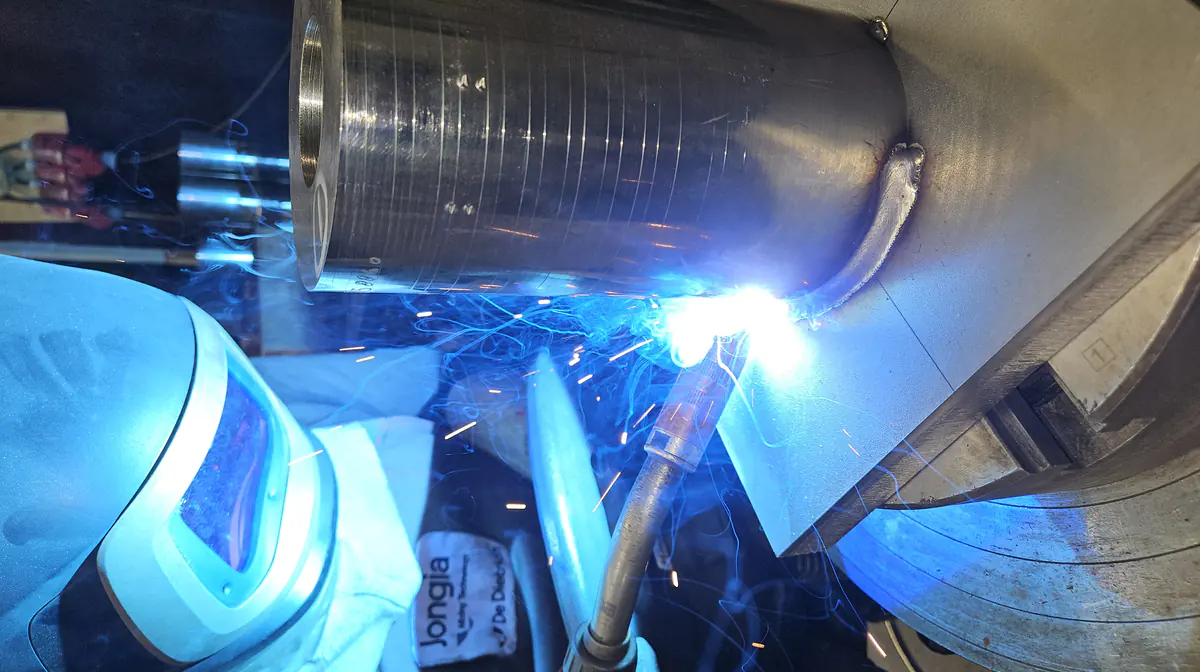
The procedure qualification record (PQR): what it is and how it works
A procedure qualification record, or PQR, is the document under ASME Section IX that records the welding of a test coupon and the results of its testing. It captures the variables that were actually used and proves that the resulting weld has the required mechanical properties. Together with the WPS, the PQR is the foundation of every qualified welding procedure under the ASME codes, and AWS D1.1 uses the same concept.
For fabricators supplying work under ASME Section VIII, ASME B31.3 or AWS D1.1, the PQR is usually the first document a client's inspector or Authorized Inspector asks to see. This article explains what a PQR contains, how the WPS and PQR relate, how the PQR differs from the European WPQR, and which mistakes we come across most often in PQR welding documentation.
What is a procedure qualification record
ASME IX defines the PQR in QW-200.2 as a record of the welding data used to weld a test coupon, together with the test results. The PQR is a record of what actually happened, not a working instruction. It lists actual values, such as the measured amperage and the actual preheat temperature, rather than ranges.
The organisation qualifying the procedure owns the PQR. The coupon must be welded under its full supervision and control, and the organisation certifies by signature that the data are correct and that the coupon was welded and tested in accordance with ASME IX.
WPS and PQR: how they fit together
The WPS is the written instruction the welder follows in production, and it must reference one or more supporting PQRs. The ranges on the WPS are derived from the PQR using the variable tables for each process in QW-250.
- Essential variables: a change outside the qualified range requires a new PQR.
- Supplementary essential variables: apply only when the construction code requires notch toughness testing.
- Nonessential variables: may be changed on the WPS without a new test.
One PQR can support several WPSs, and one WPS can be supported by several PQRs. Our article on the difference between a WPS and a WPQR covers the roles of both documents in more detail.
What a PQR contains
A PQR must record all essential variables and, where toughness testing is required, the supplementary essential variables. Nonessential variables may be recorded at the organisation's option. In practice a sound PQR includes:
- joint design and welding process;
- base metal specification, P-Number and coupon thickness;
- filler metal SFA specification, AWS classification, F-Number and A-Number;
- welding position, preheat and maximum interpass temperature;
- post-weld heat treatment temperature and time;
- shielding gas, current type, amperage, voltage, travel speed and heat input;
- test results with laboratory report numbers;
- the welder's name and the organisation's signature.
Which tests does a PQR require
For a groove weld, ASME IX requires two tension tests and four guided bend tests. Up to 3/8 in thickness that means two face bends and two root bends. From 3/4 in, four side bends are mandatory, and in between side bends may replace face and root bends. Notch toughness tests are needed only when the construction code or client specification calls for them.
Engineers used to European standards are often surprised that ASME IX requires no volumetric examination of the PQR coupon itself, and that hardness testing and macro examination are not standard for a groove weld. Client specifications frequently add them, for example for sour service or hardness limits in oil and gas.
PQR versus the European WPQR
The European counterpart of the PQR is the WPQR to EN ISO 15614-1. Both record a welding test and its results, but the principles differ. For a WPQR the test piece is welded in the presence of an examiner or examining body, which also endorses the record. Under ASME IX the organisation signs for itself.
EN ISO 15614-1 also requires non-destructive testing of the test piece and, in most cases, hardness testing and macro examination. Materials are grouped to ISO/TR 15608 rather than by P-Number, and the ranges of qualification differ. Since the 2017 edition, EN ISO 15614-1 has two levels, with level 1 based on the requirements of ASME IX. For a full comparison, read ASME IX versus ISO 15614-1.
Common PQR mistakes
- Ranges instead of measured values: a PQR stating 150 to 200 A does not show what was actually welded.
- No heat input: without recorded heat input the PQR becomes useless once a project requires impact testing.
- Incomplete PWHT data: temperature and time both affect coverage and must be fully recorded.
- Wrong bend tests: face and root bends where side bends were mandatory.
- A WPS that exceeds the PQR: for example a thickness range beyond what the coupon supports.
- Missing signature or report numbers: the origin of the results can then not be demonstrated.
If you have doubts about an existing PQR or need a new one, DEHAAS can prepare and manage the procedure qualification independently.
PQRs under AWS D1.1 and standard procedures
AWS D1.1 also uses PQRs, but it additionally allows prequalified WPSs. Stay within the code's strict limits for material, joint design, process and parameters and no welding test is needed. Outside those limits, qualification by testing with a PQR is required. ASME IX offers a comparable route through the standard welding procedure specifications of the AWS B2.1 series, which Article V of ASME IX permits without an in-house PQR, subject to the conditions set out there.
Frequently asked questions
Not in substance, because the PQR records what actually happened. ASME IX permits only editorial corrections and addenda, for example when a new code edition assigns a material to a different P-Number.
A PQR under ASME IX has no expiry date. It remains usable unless a code change affects the qualification. Welder qualifications are different: they lapse when a welder has not used the process for more than six months.
In principle, no. The organisation using the WPS must have welded the test coupon under its own supervision and control. ASME IX allows limited exceptions, for instance after a change of ownership or for locations under the same quality programme.
The PQR qualifies the procedure, the WPQ qualifies the welder. A welder who successfully welds the PQR coupon is also qualified, within the limits set by ASME IX.
More from the knowledge centre
Have a welding or QA/QC question?
Ask the DEHAAS Welding & Quality Assistant, have your case reviewed by a specialist, or call us directly.