Full penetration: when required and how to prove it
Full penetration is the most expensive joint you can specify: more preparation, more weld metal, more shrinkage, more examination. But where it is needed there is no alternative, because a partial penetration joint contains by definition an unfused gap that behaves like a crack.
This article addresses when to require full penetration, what the alternative is, and how to demonstrate that the penetration is genuinely there.
When full penetration is needed
Three situations almost always require it. First, where the full plate strength must be transferred, such as a butt joint in a tension member. Second, under fluctuating load, because an unfused root is a built-in notch with a low detail category.
Third, in service where a crevice is unacceptable: pressure equipment, piping carrying a fluid, hygienic applications and anything where crevice corrosion can occur. Outside those three, a correctly sized fillet weld is often the better choice.
Partial penetration as a middle ground
A partial penetration weld, with a specified depth, sits in between. It carries more than a fillet and costs less than full penetration, but retains the unfused root. EN 1993-1-8 gives rules for the effective throat of such a joint.
The danger lies in assumption: a joint that 'more or less penetrates' is not demonstrable. The penetration depth must be qualified and shown on the drawing, otherwise the actual capacity is unknown.
Demonstrating that the root has fused
On joints accessible from both sides, the usual route is back gouging and grinding of the root followed by a sealing run. That removes the root defect and allows visual verification. The gouging operation is recorded in the WPS, including how the surface is cleaned afterwards.
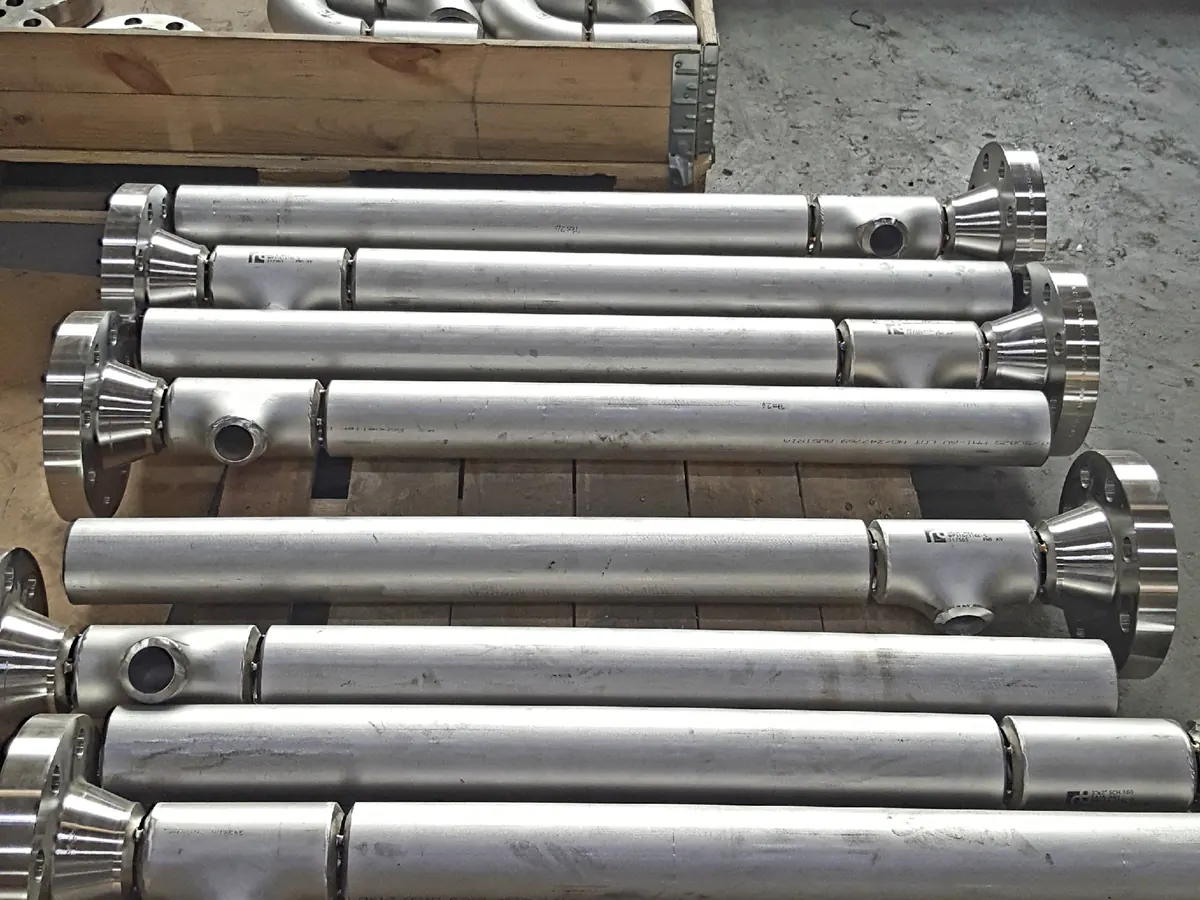
On single sided welds, such as piping, that is impossible. The root is then the critical part and is demonstrated by radiographic or ultrasonic testing, or by borescope where the pipe allows. The welder must be qualified in that position and technique.
The role of qualification
A WPQR for a full penetration joint does not automatically cover welding without backing if the qualification used backing, and a qualification with back gouging does not automatically cover single sided welding. Root treatment is an essential variable.
That is one of the most common errors in procedure books: a WPQR properly made for full penetration but with a different root technique than production uses. See WPQR validity range and essential variables.
Frequently asked questions
A groove weld without a size normally means full penetration. Where a number is given, that is the required depth and it concerns partial penetration. See welding symbols.
Only where the standard and the application permit it. A permanent backing strip creates a crevice between strip and plate, undesirable under fatigue and for corrosion. In pressure equipment and hygienic applications it is generally not allowed.
Structurally yes, but it also brings more shrinkage, more residual stress and more risk of distortion. Where a fillet suffices, requiring full penetration is an unnecessary cost and sometimes detrimental to dimensional accuracy.
As a minimum visual examination, supplemented by volumetric examination, radiographic or ultrasonic, in an extent following from the execution class or product standard. On single sided welds that examination is the only way to assess the root.
More from the knowledge centre
Have a welding or QA/QC question?
Ask the DEHAAS Welding & Quality Assistant, have your case reviewed by a specialist, or call us directly.