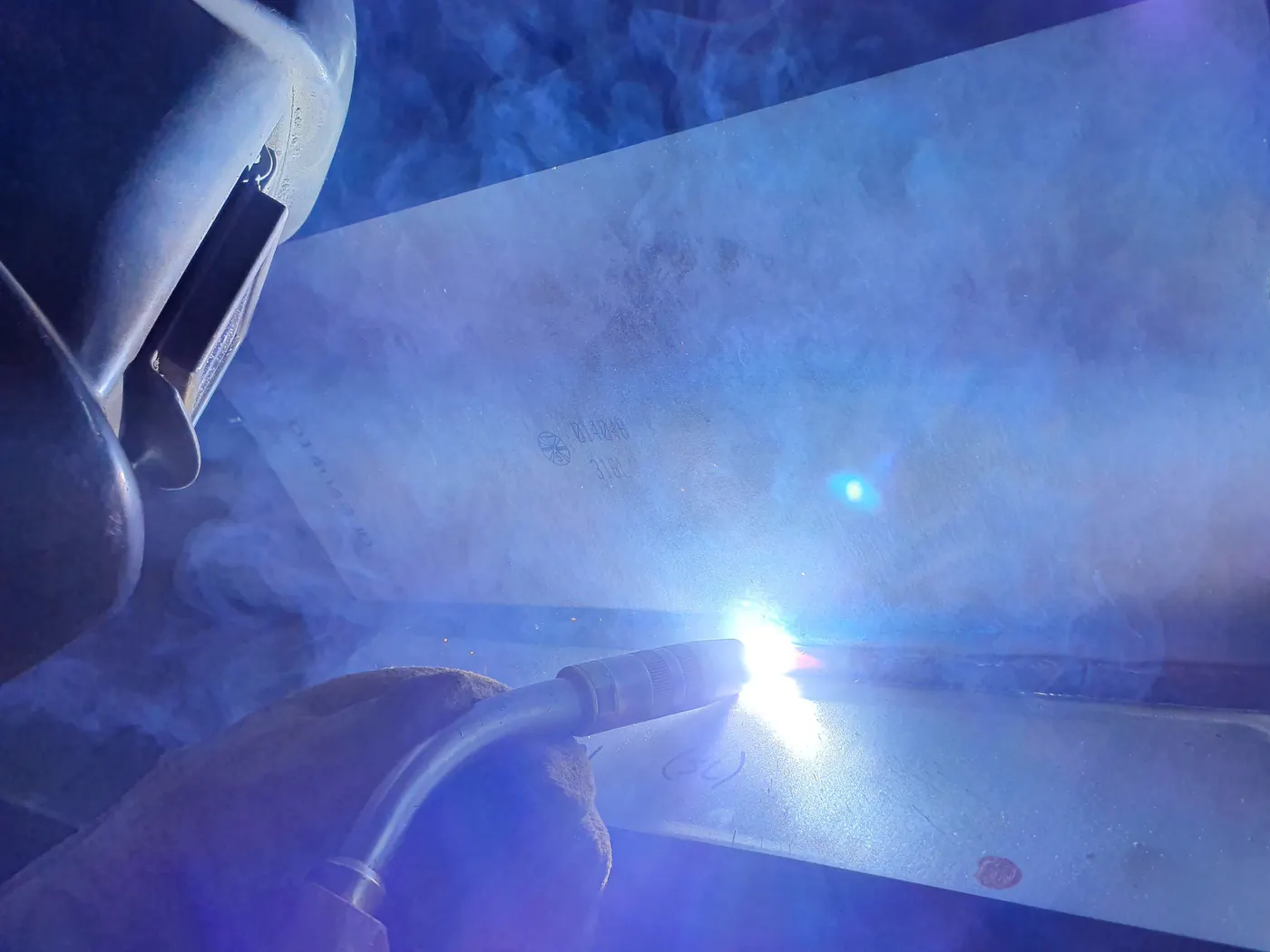
Welding wear resistant steel
Wear resistant steel owes its hardness to a martensitic structure obtained by quenching. Welding destroys that structure locally: a softened zone forms in the heat affected zone and does not return. That is not a defect but a given the design must accommodate.
At the same time the material is crack sensitive because of that same hardness. This article covers both sides of the problem.
What happens in the HAZ
The parent material has a hardness of 400 to 500 HBW depending on grade. Beside the weld the material is reheated and then cools more slowly than during the original quench. The result is a tempered zone whose hardness can fall below 300 HBW.
That softened zone is a few millimetres wide and wears faster than the material around it. In a chute or hopper a groove develops there over time. The design must therefore keep welds away from the most heavily worn zones, or protect them with hardfacing.
Preheat and carbon equivalent
Wear plate has a relatively high carbon equivalent and is therefore susceptible to hydrogen cracking. Manufacturers publish preheat tables per grade and thickness, and those govern. On thin plate preheat may be omitted; on heavier sections it rises to 125 or 175 degrees.
Always use low hydrogen consumables and keep them dry. The combination of a hard structure, residual stress and hydrogen is exactly the threefold condition for cold cracking. See preventing hydrogen cracking.
Undermatching consumables
It seems logical to choose equally hard weld metal, but that is precisely wrong. A soft, tough weld metal in the 460 to 500 N/mm2 class absorbs deformation and lowers stress in the crack sensitive HAZ. The weld is then softer than the plate, and that is accepted design.
Where the surface must be wear resistant, a hard overlay is applied separately from the structural joint. Separating those two functions is the proven approach.
Cutting and forming
Thermal cutting hardens the cut edge further. On thicker plate, preheat is applied during cutting and the edge is subsequently ground to remove the hardened layer, particularly where welding will follow in or near that edge.
Cold forming requires generous bend radii in the direction the manufacturer specifies, because high hardness combined with a tight radius causes cracking. Punching and flame cut holes are equally points of attention in this material.
Frequently asked questions
Yes, and that is the recommended route: a common low hydrogen wire in the 460 or 500 class. Choosing a hard wire raises cracking risk without improving the joint.
Typically a few millimetres either side of the weld, depending on heat input and thickness. The lower the heat input, the narrower. It cannot be prevented entirely; the design must accommodate it.
No, and it is usually harmful: stress relief at the usual temperature tempers the whole plate and lowers hardness across a far larger area than the HAZ alone. The hardness does not return.
That depends on the grade. Some suppliers offer variants with a guaranteed yield strength that may be used structurally; others are intended purely as wear plate. Check the material certificate and product specification before using it in a calculation.
More from the knowledge centre
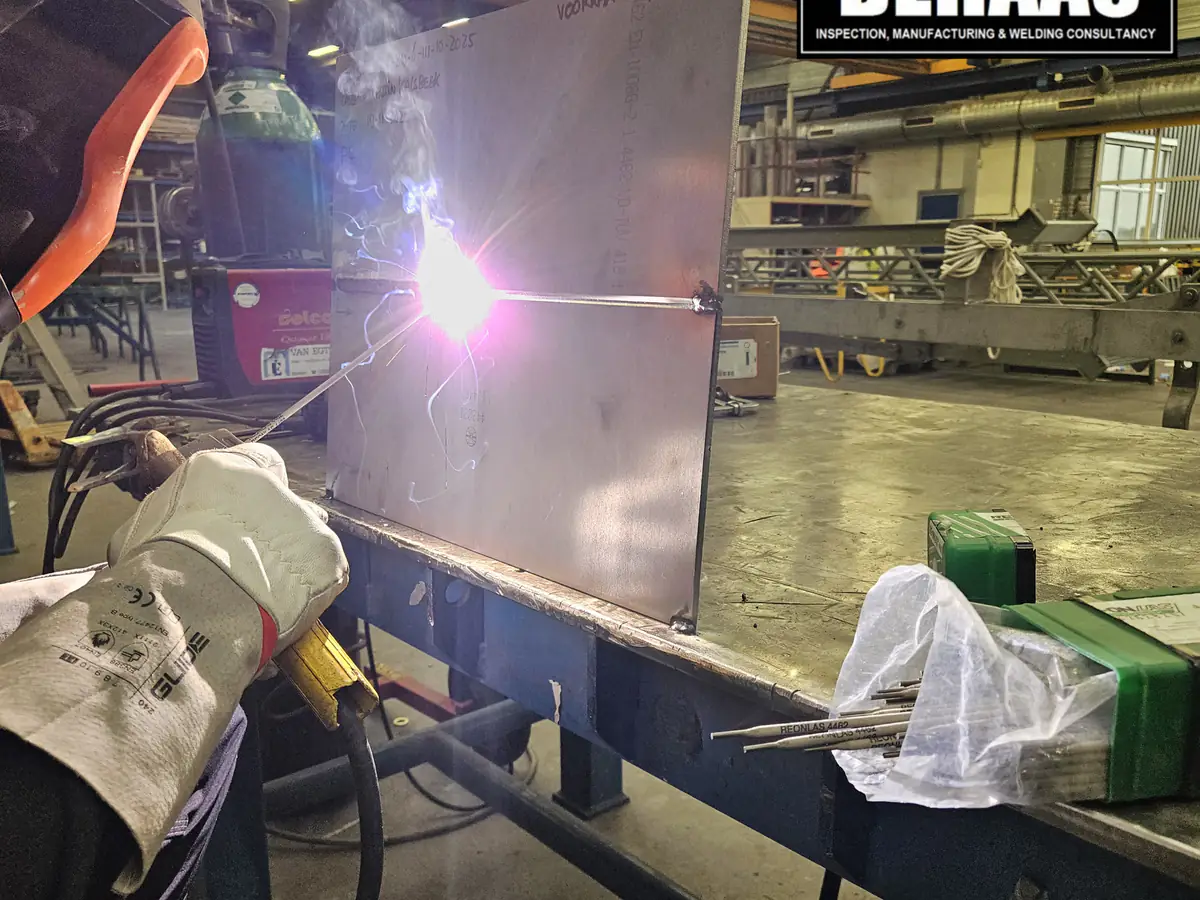
Have a welding or QA/QC question?
Ask the DEHAAS Welding & Quality Assistant, have your case reviewed by a specialist, or call us directly.