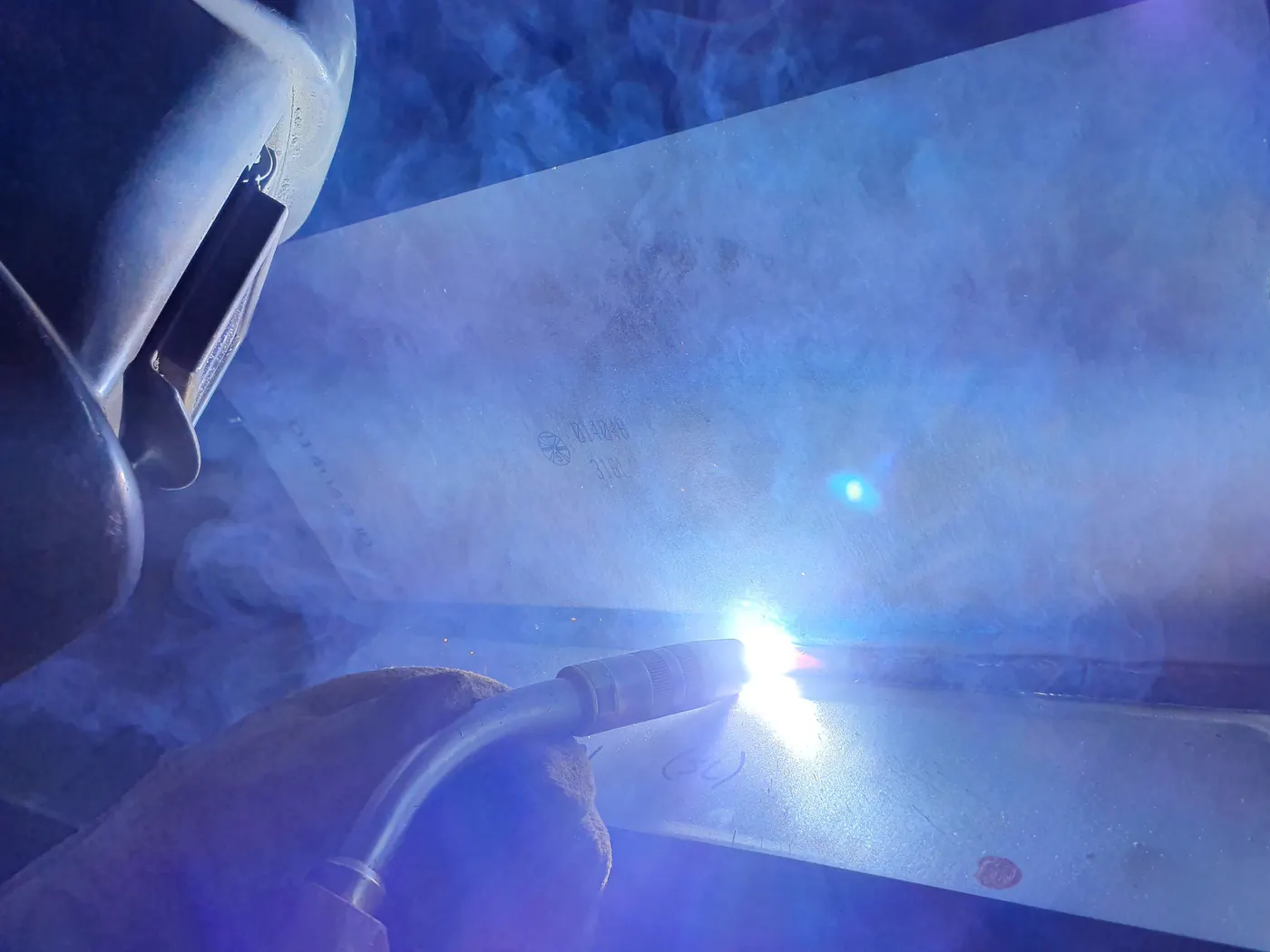
Welding copper and bronze
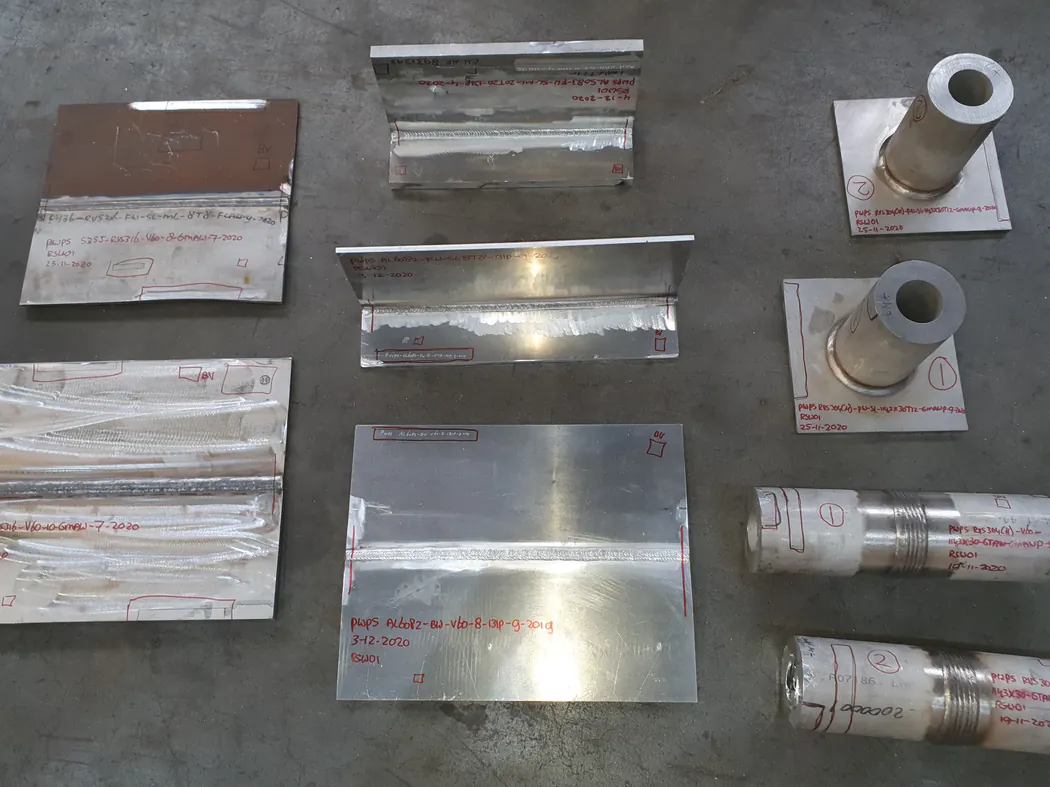
Copper conducts heat roughly eight times better than steel. Whatever you put into the arc disappears instantly into the workpiece, and without preheat you cannot open the pool. That makes copper less prone to stress than steel but far harder to get started.
The alloys add two risks of their own: oxygen in the copper and zinc fume from brass. This article covers both.
Thermal conductivity and preheat
Because of the high conductivity the whole component must be heated. For thin copper 100 to 200 degrees suffices; on heavier material that rises to 400 or 500 degrees. Without preheat you get cold laps and lack of fusion, even at ample current.
Helium or an argon helium mixture helps considerably, because helium raises arc voltage and therefore heat input. On heavy copper, TIG with helium or MIG with a high helium content is the usual route.
Oxygen free or tough pitch copper
Tough pitch copper, the common electrolytic grade, contains a small amount of oxygen as copper oxide. During welding that oxygen reacts with hydrogen to form steam, which remains in the material and causes porosity and micro cracks. That is known as hydrogen disease.
Welded work therefore uses oxygen free copper, designated Cu-OF or Cu-DHP, where oxygen is negligible or bound by phosphorus. Welding tough pitch copper is possible but rarely yields a sound, reliable joint.
Brass, bronze and zinc fume
Brass contains zinc, which vaporises at around 907 degrees while the brass itself only melts around 900 to 940 degrees. During welding the zinc therefore boils off vigorously, producing white fume, altering the weld metal composition and making the weld porous.
Brass is consequently rarely fusion welded and usually brazed. Where it is welded, powerful local extraction is essential: zinc oxide causes metal fume fever. Older alloys may contain cadmium, whose fume is considerably more dangerous. See welding fume.
Filler metal and process
For pure copper a phosphorus bearing copper rod is used, which binds the oxygen. Aluminium bronze and silicon bronze have their own consumables, which are also widely used to join steel and stainless cold by MIG brazing.
MIG brazing with silicon bronze is in fact a technique in its own right: the arc melts the filler but not the parent material, so virtually no heat affected zone forms. It is widely used on thin galvanised sheet in body repair.
Frequently asked questions
Almost always insufficient preheat or heat input. Copper conducts heat away faster than you put it in. Preheat the whole component, use helium in the gas and work at higher current than you would on steel.
It is possible, but rarely the best choice because of zinc fume and porosity. Brazing usually gives a better joint with less risk. Where welding is required, ensure local extraction and check for cadmium in older alloys.
The reaction between oxygen in tough pitch copper and hydrogen from moisture or the arc, forming steam inside the material. That steam cannot escape and causes porosity and micro cracks. Oxygen free copper prevents it.
No. In MIG brazing only the filler melts and bonds to the parent material without melting it. The zinc coating on galvanised sheet therefore stays largely intact and distortion is minimal. Qualification follows different standards than fusion welding.
More from the knowledge centre
Have a welding or QA/QC question?
Ask the DEHAAS Welding & Quality Assistant, have your case reviewed by a specialist, or call us directly.